Daylight saving time depression can sneak up on you. The clocks fell back on Sunday, November 1, and suddenly it is dark before dinner. You are tired by 4 p.m., your motivation is gone, and the couch feels like the only reasonable plan for the evening. If that sounds familiar, you are not imagining it, and you are not alone.
At our Mansfield and McKinney offices, the first few weeks of November are when many people tell us something feels “off.” Sometimes it is a short adjustment that fades in a week or two. Other times, the time change is the first domino in a longer stretch of seasonal depression that lasts into spring.
This guide explains why the end of daylight saving time affects mood, how to tell the time change blues apart from seasonal affective disorder, and nine practical, proven ways to recover. It also covers when it is time to call a professional, because some seasons are too heavy to push through on willpower alone.
Table of Contents
What Is Daylight Saving Time Depression?
Daylight saving time depression is not a separate clinical diagnosis. It is a common way to describe the drop in mood, energy, and sleep quality that many people notice right after the clocks fall back in the fall. For some, it is a mild, short-lived slump. For others, it marks the start of seasonal affective disorder (SAD), a recognized form of depression that follows a seasonal pattern.
The research backs up what people feel. A large Danish study published in the journal Epidemiology found that hospital diagnoses of depressive episodes rose by roughly 11% in the weeks right after the switch from daylight saving time to standard time, before gradually tapering off (PubMed, Hansen et al.). The authors linked the jump to the sudden loss of evening daylight, not just the shorter days of winter.
The American Psychiatric Association estimates that seasonal affective disorder affects about 5% of adults in the U.S., and that it typically lasts around 40% of the year (American Psychiatric Association). Many more people experience a milder version often called the “winter blues.”
Why the Time Change Hits Your Mood So Hard
Moving the clock by one hour sounds minor. Your brain does not see it that way. Here is what is happening behind the scenes when time change depression sets in.
Your Internal Clock Gets Out of Sync
Your body runs on a roughly 24-hour circadian rhythm that controls sleep, hunger, hormones, body temperature, and alertness. Light is the main signal that keeps that rhythm on track. When the clock shifts suddenly, your social schedule (work, school, meals) moves, but your internal clock does not move with it right away. That mismatch can leave you groggy, irritable, and low for days or even weeks.
Less Evening Light Means Less Serotonin
Sunlight helps regulate serotonin, a brain chemical tied to mood. After the switch, most of us leave work or school in the dark. Less daylight exposure, especially during the hours we are awake and active, is one reason the end of daylight saving time can trigger or worsen depressive symptoms.
Darkness Boosts Melatonin Earlier
Melatonin is the hormone that tells your body it is time to sleep. Earlier darkness can push melatonin production earlier in the evening, which is why you might feel ready for bed at 7 p.m. but still struggle to sleep well. Poor sleep and low mood feed each other, which can turn a rough week into a rough season.
Routines and Social Plans Shrink
Fewer daylight hours often mean fewer evening walks, fewer outdoor activities, and fewer chances to see friends. Withdrawal is both a symptom of depression and a cause of it. When the calendar empties out at the same time light disappears, mood often follows.
Signs of Time Change Depression to Watch For
Symptoms often show up within days of the clocks falling back. Common signs of daylight saving time depression include:
- Feeling sad, flat, or “heavy” most of the day
- Low energy and fatigue, even after a full night of sleep
- Sleeping much more than usual or having trouble waking up
- Strong cravings for carbohydrates and sweets, with weight gain
- Losing interest in activities you normally enjoy
- Trouble concentrating at work or school
- Pulling away from friends and family (“hibernating”)
- Irritability or feeling more easily overwhelmed
- Feelings of hopelessness, guilt, or worthlessness
Kids and teens can feel this too. In younger people, it may look more like irritability, falling grades, oversleeping, or dropping out of activities than obvious sadness.
Who Is Most at Risk for Daylight Saving Time Depression?
Anyone can feel the effects of the time change, but some people tend to be hit harder. You may be more likely to experience daylight saving time depression if you:
- Have a personal or family history of depression, bipolar disorder, or seasonal affective disorder
- Already live with anxiety, ADHD, or another mental health condition
- Work early mornings, night shifts, or rotating schedules
- Spend most of the day indoors with little natural light
- Are a teen or young adult, an age group in which SAD often first appears
- Are going through a stressful life change, grief, or isolation
Women are also diagnosed with seasonal affective disorder more often than men. Having a risk factor does not mean you will struggle, but it is a good reason to plan ahead each fall instead of waiting to see how you feel.
Time Change Blues vs. Seasonal Affective Disorder: What’s the Difference?
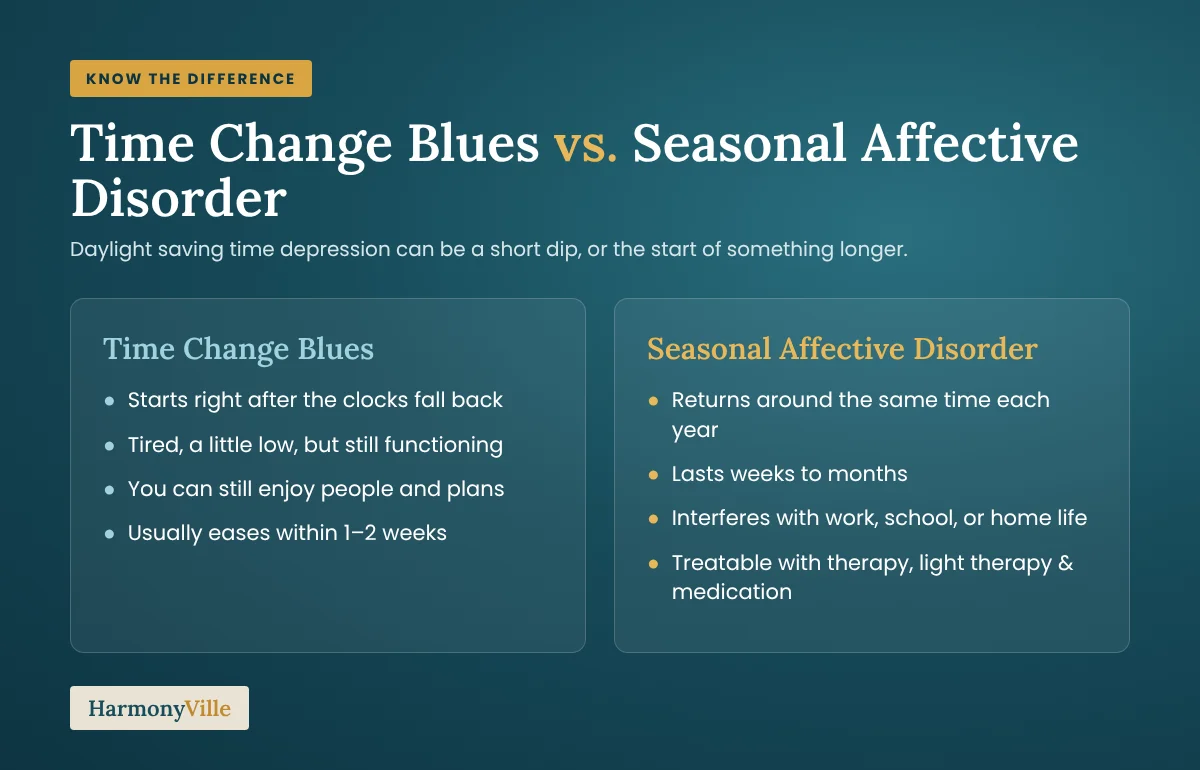
Not every dip in mood after the time change is depression. Here is a simple way to think about the difference.
The time change blues usually show up right after the clocks shift. You feel tired and a little low, but you can still work, enjoy time with people you love, and get through your day. Symptoms tend to ease within one to two weeks as your body adjusts.
Seasonal affective disorder is a type of major depression with a seasonal pattern. Symptoms last longer, usually weeks to months, and they interfere with daily life. People with SAD often notice the same pattern returning around the same time each year. According to the National Institute of Mental Health, SAD is treatable with options such as light therapy, psychotherapy, and medication.
If you are not sure which one you are dealing with, a good rule of thumb is this: if symptoms last more than two weeks, keep getting worse, or make it hard to function, it is worth talking to a mental health professional. You can also read our related guide, Seasonal Depression: 7 Proven Ways to Feel Better This Winter.
9 Proven Ways to Recover From Daylight Saving Time Depression
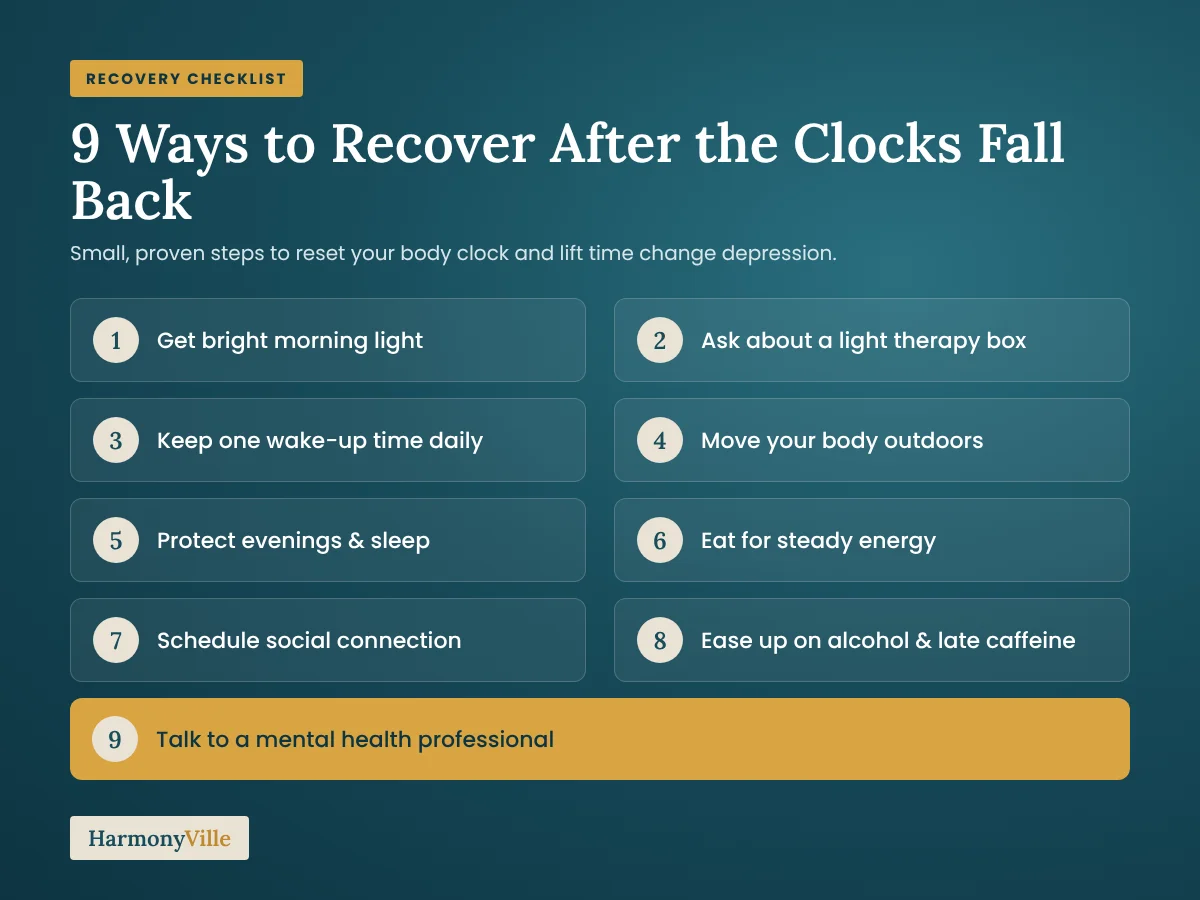
The good news: there is a lot you can do. These strategies help your body reset its internal clock and support your mood through the darker months. Start with one or two, then build from there.
1. Get Bright Morning Light Within an Hour of Waking
Morning light is the single strongest signal for resetting your internal clock. Step outside for 15 to 30 minutes soon after you wake up, even on a cloudy day. Drink your coffee on the patio, walk the dog, or park farther away from the office. Outdoor light, even in winter, is much brighter than typical indoor lighting.
2. Ask Your Provider About a Light Therapy Box
Light therapy is one of the best-studied treatments for seasonal affective disorder. It usually involves sitting near a 10,000-lux light box for a set time each morning. Because timing, intensity, and safety matter (especially for people with bipolar disorder, certain eye conditions, or light-sensitive medications), talk with a provider before you start. They can help you choose the right device and schedule.
3. Keep the Same Wake-Up Time Every Day
A consistent wake time anchors your circadian rhythm more than a consistent bedtime does. Try to get up at the same time on weekdays and weekends, within about 30 minutes. If you need to adjust, shift your schedule gradually by 15 minutes a day instead of all at once.
4. Move Your Body, Ideally Outdoors
Regular physical activity is linked to better mood and better sleep. You do not need an intense workout. A brisk 20-minute walk at lunch gives you movement and daylight at the same time. If evenings are your only free time, a well-lit gym or an indoor class still helps.
5. Protect Your Evenings and Your Sleep
When it is dark at 5:30 p.m., it is easy to nap on the couch and then lie awake at midnight. Avoid long late-afternoon naps. Keep the house brightly lit in the early evening, then dim lights and screens about an hour before bed. A cool, dark, quiet bedroom supports deeper sleep.
6. Eat for Steady Energy
Carb cravings are common with seasonal depression. Rather than fighting them with willpower, build meals around protein, fiber, and healthy fats so your energy stays steady. Ask your primary care provider whether checking your vitamin D level makes sense for you before starting supplements.
7. Schedule Social Connection on Purpose
Depression tells you to stay home. Connection is one of the most reliable buffers against it. Put plans on the calendar before you can talk yourself out of them: a weekly coffee with a friend, a standing family dinner, a faith or community group, or a class. Even a short phone call counts.
8. Go Easy on Alcohol and Late Caffeine
Alcohol may feel relaxing in the moment, but it disrupts sleep and can worsen low mood. Caffeine after noon can also make it harder to fall asleep at your new bedtime. Small changes here can make the time change much easier on your body.
9. Talk to a Mental Health Professional
If self-care is not enough, that is not a personal failure. It is information. Evidence-based treatments for seasonal depression include cognitive behavioral therapy (CBT), which helps you change the thought patterns and habits that keep you stuck, and medication when appropriate. Our individual therapy and psychiatry and medication management services are designed to help you feel like yourself again.
A Simple 7-Day Reset Plan for Time Change Depression
Knowing what helps is one thing. Doing it while you feel tired and low is another. This one-week plan breaks recovery into small steps so it feels doable.
- Day 1: Pick a wake-up time you can keep every day, including weekends, and set an alarm across the room.
- Day 2: Spend 15 minutes outside within an hour of waking. Coffee on the porch counts.
- Day 3: Add a 20-minute walk during daylight, ideally around lunchtime.
- Day 4: Set a “screens down” time one hour before bed and dim the lights in your home.
- Day 5: Text one friend or family member and put a plan on the calendar for this week.
- Day 6: Swap one sugary snack for a protein-rich option, and cut caffeine after noon.
- Day 7: Check in with yourself. Rate your mood, energy, and sleep from 1 to 10 and compare them with Day 1.
If your numbers are not improving after a week or two, that is a clear signal to get support. Daylight saving time depression responds well to treatment, and you do not have to wait until spring to feel better.
When Daylight Saving Time Depression Needs Professional Care
Reach out to a mental health provider if you notice any of the following:
- Symptoms last longer than two weeks or keep getting worse
- You are struggling to work, study, or take care of daily responsibilities
- You are sleeping far more or far less than usual most nights
- You are relying on alcohol or other substances to cope
- Your mood dips the same way around the same time every year
- You feel hopeless or have thoughts of harming yourself
If you are in crisis or thinking about suicide, call or text 988 to reach the 988 Suicide & Crisis Lifeline, available 24/7. If you are in immediate danger, call 911 or go to the nearest emergency room.
For people whose depression has not improved with medication and therapy, advanced options may help. TMS therapy, for example, is an FDA-cleared, non-medication treatment for some forms of depression. A provider can help determine whether it is a good fit for you.
How HarmonyVille Helps With Seasonal Depression in Mansfield & McKinney, TX
At HarmonyVille Mental & Behavioral Health Services, we see seasonal mood changes every fall. Our board-certified providers and therapists take time to understand what you are experiencing, rule out other causes, and build a plan that fits your life. That plan might include therapy, medication management, practical lifestyle changes, or a combination of approaches.
We care for children, teens, and adults at our Mansfield, TX office and our McKinney, TX office, with telehealth available for many visits. Learn more about our approach to depression treatment.
The holidays can add their own stress on top of shorter days. If that is part of the picture, our guide on coping with holiday depression may help, too.
Frequently Asked Questions About Daylight Saving Time Depression
How long does daylight saving time depression last?
For most people, the time change blues ease within one to two weeks as the body adjusts to the new schedule. If low mood, fatigue, or sleep changes last longer than two weeks, or start to interfere with daily life, it may be seasonal affective disorder or another form of depression, and it is a good idea to talk with a mental health professional.
Can the time change really cause depression?
The time change does not cause depression on its own for everyone, but it can trigger or worsen symptoms, especially in people who are already vulnerable. A large Danish study found depressive episode diagnoses rose by about 11% in the weeks after clocks moved from daylight saving time to standard time. Losing evening light and disrupting the body clock both appear to play a role.
Is daylight saving time depression the same as seasonal affective disorder?
Not exactly. Daylight saving time depression is an informal term for the mood dip many people feel right after the clocks change. Seasonal affective disorder (SAD) is a clinical diagnosis: a type of major depression that returns at the same time each year and lasts weeks to months. The time change can be the starting point for SAD in some people.
What helps with time change depression fast?
The quickest wins are bright morning light within an hour of waking, a consistent wake-up time seven days a week, a daily outdoor walk, and limiting late naps, alcohol, and afternoon caffeine. If those steps are not enough after a couple of weeks, therapy, light therapy guided by a provider, or medication can help.
Can children and teens experience seasonal depression after the clocks change?
Yes. Children and teens can be affected, and it often looks like irritability, oversleeping, trouble with schoolwork, or pulling away from friends rather than obvious sadness. If you notice these changes in your child, our child and adolescent psychiatry team can help.
Feel Like Yourself Again This Season
Daylight saving time depression is real, common, and treatable. Shorter days do not have to mean a lost season. If the time change has left you feeling drained, low, or not like yourself, our team in Mansfield and McKinney is here to help.
Ready to get support for daylight saving time depression? Request an appointment at HarmonyVille in Mansfield or McKinney, TX, or call our team today. In-person and telehealth visits are available.