If you have ever sat in a waiting room convinced you were the only person who felt this way, you already understand one of the biggest benefits of group therapy: you find out you are not alone. At HarmonyVille, our small, clinician-led groups in Mansfield and McKinney, TX give teens and adults a safe, structured place to talk, listen, practice new skills, and heal alongside people who truly get it.
Many people picture group therapy as a circle of strangers forced to share their deepest secrets. In reality, a well-run group feels more like a guided workshop with real human connection built in. This guide walks you through the proven benefits of group therapy, what a session at HarmonyVille actually looks like, and how to decide whether a group is the right next step for you or someone you love.
Table of Contents
What Is Group Therapy?
Group therapy is a form of psychotherapy where a small number of people meet regularly with one or more trained clinicians to work on shared concerns. Instead of one-on-one conversation, members learn from the clinician and from each other. Each session usually has a focus, such as managing anxious thoughts, coping with low mood, or building healthier relationships.
At HarmonyVille, our groups are small, closed cohorts. That means you meet with the same six to ten people each week, which helps trust grow quickly. Every session includes a topic, a guided discussion, and a practical skill to try. It is not open-ended venting; it is focused, supportive work with a clear purpose.

The Benefits of Group Therapy at a Glance
Before we go deeper, here is a quick summary. The benefits of group therapy reach well beyond simply “talking it out.” Members often describe feeling less isolated, more confident in social settings, and better equipped with tools they can use the same day. Because you see real people working through real challenges, progress often feels more tangible and more hopeful.
- Connection: You meet people who understand what you are going through.
- Practice: You rehearse new coping and communication skills in a safe room.
- Perspective: You hear many viewpoints, not just your own inner voice.
- Accountability: A weekly rhythm keeps you moving forward.
- Evidence: Research shows groups can work as well as individual therapy for many conditions.
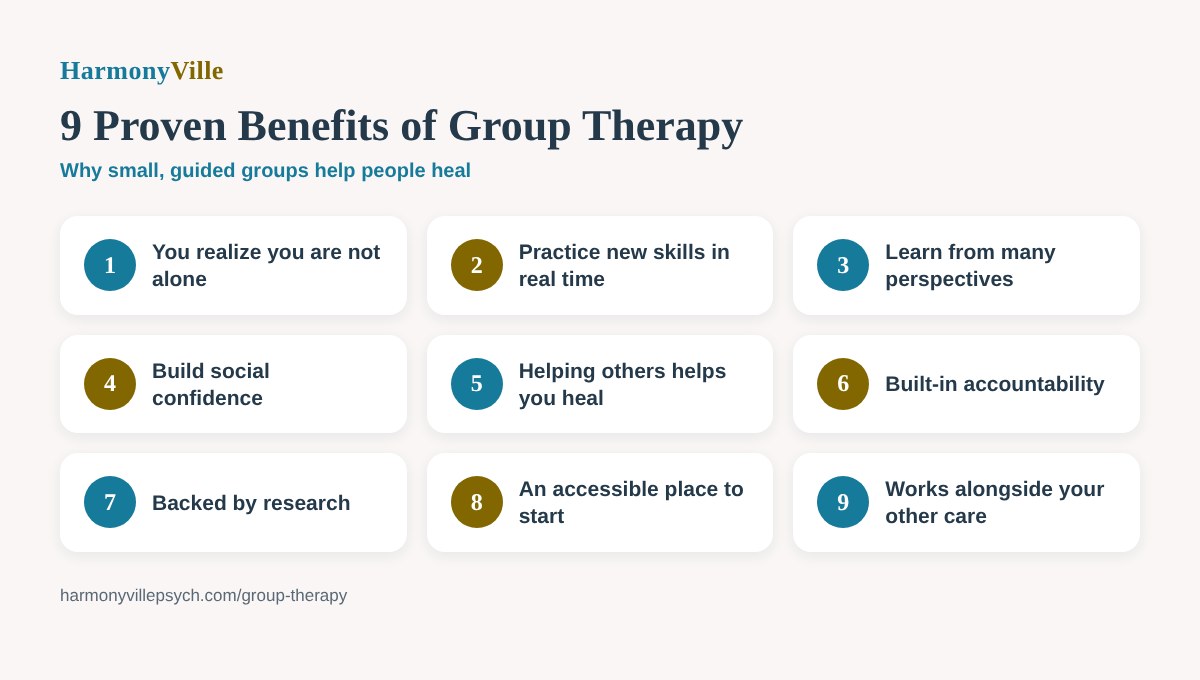
9 Proven Benefits of Group Therapy
Every group is different, and every member brings a unique story. Still, clinicians see the same powerful patterns again and again. Here are nine of the most meaningful benefits of group therapy, and why each one matters for your mental health.
1. You Realize You Are Not Alone
Anxiety, depression, and grief can whisper that something is uniquely wrong with you. Hearing another person describe the exact thought you have been hiding is often a turning point. Psychologists call this “universality,” and it is one of the most healing benefits of group therapy. Shame tends to shrink the moment it is spoken out loud and met with understanding instead of judgment.
2. You Practice New Skills in Real Time
In individual therapy, you might talk about how to set a boundary or speak up when you feel overlooked. In a group, you can actually try it, with a clinician guiding you and peers offering gentle, honest feedback. This live practice is one of the most practical benefits of group therapy, because skills rehearsed in a safe room are far easier to use at work, at school, or at home.
3. You Learn From Many Perspectives
When you are stuck, your own thinking can feel like the only way to see a problem. Group members come from different ages, backgrounds, and life stages. One person may share a coping strategy you never considered. Another may reflect back a strength you did not know you had. This variety of insight is a benefit you simply cannot get from a single conversation.
4. You Build Social Confidence
For people living with social anxiety or avoidance, the group itself becomes a gradual, supportive form of exposure. You start by listening. Over time, you may share a sentence, then a story. Each small step builds evidence that you can be seen and still be safe. Many members tell us this growing confidence quietly spills over into friendships, classrooms, and workplaces.
5. Helping Others Helps You Heal
One of the most surprising benefits of group therapy is how good it feels to support someone else. When you offer encouragement or share what worked for you, you are reminded that your experience has value. This sense of purpose can lift mood, strengthen self-worth, and turn painful chapters of your life into something that helps another person move forward.
6. You Get Built-In Accountability and Structure
Change is easier when someone is cheering you on. Our groups meet weekly for 90 minutes, and members often check in on the goals they set the week before. That steady rhythm creates gentle accountability. It also gives your week a dependable anchor, which can be especially helpful during stressful seasons or after a major life change.
7. Research Supports Its Effectiveness
Group therapy is not a “lesser” option. According to the American Psychological Association’s Monitor on Psychology, decades of research, including dozens of randomized trials comparing the two formats, show that group therapy can be about as effective as individual therapy for many conditions, including depression and PTSD. You can read more in the APA’s article, Power in Numbers. A HarmonyVille provider can help you decide whether a group fits your specific needs.
8. It Can Be a More Accessible Way to Start
For many people, reaching out for help is the hardest step. A group can feel less intense than sitting face to face with a therapist, and you are never required to speak before you are ready. In many practices, group sessions also cost less per visit than individual sessions. Our team is happy to walk you through your insurance coverage and options before you begin.
9. It Works Alongside Your Other Care
You do not have to choose between formats. Many HarmonyVille patients combine a weekly group with individual therapy or medication management through our psychiatry services. Each layer reinforces the others. What you uncover in individual sessions can be practiced in group, and what comes up in group can be explored more deeply one-on-one.
Who Can Experience the Benefits of Group Therapy?
The benefits of group therapy extend to a wide range of people. You do not need a specific diagnosis to join, and you do not need to have everything figured out. Our groups at HarmonyVille are designed for teens and adults, and they are often a strong fit if you:
- Feel isolated, lonely, or misunderstood by the people around you.
- Live with social anxiety or tend to avoid situations that make you nervous.
- Are managing depression or persistent low mood and want added support.
- Are in recovery and want help with relapse prevention.
- Are navigating a big transition, such as a loss, a move, a new role, or a return to civilian life after military service.
- Want hands-on practice, not just insight, as you build new habits.
Veterans, caregivers, and first responders, for example, often tell us that being in a room with people who share similar pressures makes it easier to open up. If you are already receiving care for anxiety or depression, ask your provider whether adding a group could strengthen your progress.
Benefits of Group Therapy for Veterans and Military Families
Military service builds deep bonds, and many veterans feel that loss of camaraderie once they return home. Civilian friends may care deeply but still struggle to relate. This is where the benefits of group therapy can be especially powerful. Sitting with others who understand long deployments, high-pressure decisions, or the challenge of adjusting to everyday life can make it easier to lower your guard.
Veterans often carry stress, sleep problems, irritability, or painful memories quietly for years. A structured group offers a respectful, judgment-free place to talk about those experiences at your own pace and learn practical tools for managing them. Spouses and adult family members of service members can also benefit from group support as they navigate their own stress and transitions.
At HarmonyVille, we welcome veterans and military families in Mansfield and McKinney. During your screening call, we can talk through your goals and whether group therapy, individual therapy, psychiatric care, or a combination is the best fit. The benefits of group therapy often feel most meaningful when they are part of a complete, personalized care plan.
Common Myths That Hide the Benefits of Group Therapy
Misconceptions keep many people from ever trying a group. Let’s clear up a few of the most common ones:
- “I will have to share everything right away.” Not true. You set the pace, and listening counts as participating.
- “Group is just for people with severe problems.” Groups help people with a wide range of everyday struggles, from stress to loneliness.
- “Other people’s problems will make me feel worse.” Most members find that hearing others’ stories brings relief and hope, not heaviness.
- “Group is less professional than individual therapy.” Every HarmonyVille group is led by trained clinicians and follows a clear structure.
Once these myths fall away, the real benefits of group therapy become much easier to see: connection, growth, and a supportive community working toward the same goal.
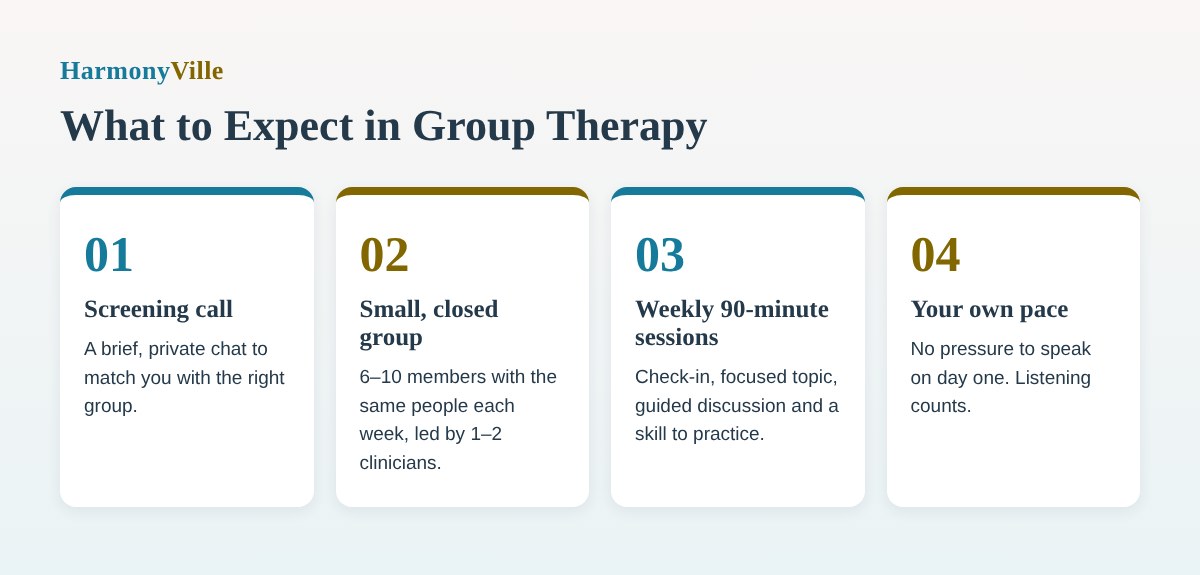
What to Expect in Group Therapy at HarmonyVille
Not knowing what will happen is a big reason people hesitate to explore the benefits of group therapy. Here is exactly what the process looks like when you join a group at our Mansfield or McKinney office.
Step 1: A Brief Screening Call
Before you join, you will have a short, private conversation with our team. We will ask about your goals and what you hope to get from a group. This helps us match you with the group where you are most likely to feel comfortable and make progress.
Step 2: Joining a Small, Closed Group
Each group includes six to ten members and is led by one or two clinicians. Because the group is closed, the same people meet each week. That consistency makes it easier to build trust and feel safe sharing.
Step 3: Weekly, Structured Sessions
Groups meet weekly for 90 minutes. A typical session starts with a check-in, moves into a focused topic and guided discussion, and ends with a skill to practice before the next meeting. You will leave with something useful every single week.
Step 4: Participating at Your Own Pace
You will not be put on the spot during your first session. Many members simply listen at first, and that is completely okay. You decide when and how much to share.
Is What You Share Kept Private?
Yes. Confidentiality is the foundation of every group we run, and it is what makes the benefits of group therapy possible. Each member signs a confidentiality agreement, and our clinicians follow the same privacy standards they use in individual care. What is shared in the room stays in the room, so everyone can speak openly and feel protected.
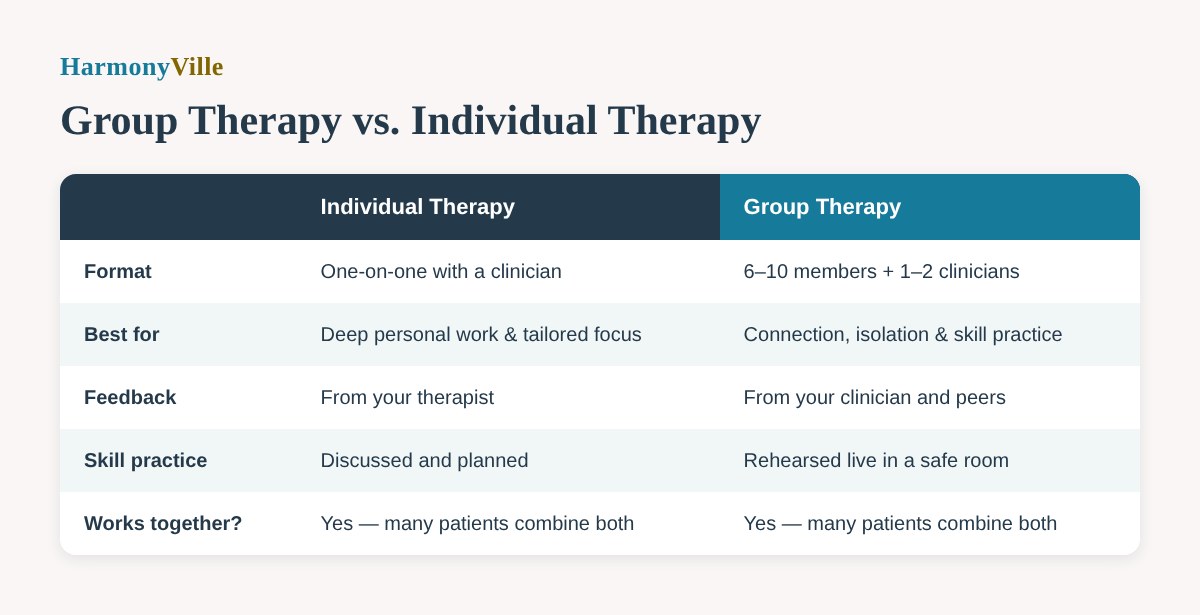
Group Therapy vs. Individual Therapy: Which Is Right for You?
Both formats are valuable, and the benefits of group therapy complement what individual care offers. Individual therapy gives you focused, one-on-one time to explore your personal history and specific concerns in depth. Group therapy adds connection, real-time practice, and the chance to learn from peers. Many people find the best results come from using both together.
Consider individual therapy first if you are working through very personal trauma you are not yet ready to discuss with others, or if you need intensive, tailored attention. Consider group therapy if isolation, social anxiety, or a desire for practical skills is part of your story. Not sure? Our clinicians can recommend a starting point during your first visit. You can also learn more on our dedicated group therapy services page.
How to Get the Most Out of Group Therapy
The benefits of group therapy grow with steady participation. These simple habits can help you make every session count:
- Show up consistently. Trust and progress build week by week.
- Start small. Sharing one honest sentence is a meaningful step.
- Listen with curiosity. Other members’ stories can unlock your own insights.
- Practice between sessions. Try the weekly skill in everyday situations.
- Be honest with your clinician. If something feels uncomfortable, say so. Adjustments are part of the process.
Frequently Asked Questions About the Benefits of Group Therapy
Is group therapy as effective as individual therapy?
For many conditions, research suggests it can be. Studies summarized by the American Psychological Association found group and individual therapy produced similar improvement for several disorders, including depression. The right choice depends on your needs, and a provider can help you decide.
What if I am too nervous to talk in a group?
That is one of the most common worries, and it is completely normal. At HarmonyVille, you are never required to speak on your first day. Many members listen for a few sessions before sharing. Feeling nervous is not a reason to skip group; for many people, it is exactly why group helps.
Is what I share in group therapy confidential?
Yes. Every member signs a confidentiality agreement, and our clinicians follow the same privacy rules used in individual care. This shared commitment helps everyone feel safe enough to be honest.
Can teens join group therapy at HarmonyVille?
Yes. Our groups serve both teens and adults, and members are matched to an appropriate group during the screening call. Parents who want to learn more about care for younger patients can also explore our child and adolescent psychiatry services.
How long does it take to feel the benefits of group therapy?
It varies from person to person. Some members feel relief after the first session, simply from realizing they are not alone. Deeper changes, like greater confidence and stronger coping skills, usually build over several weeks of consistent attendance.
Start Experiencing the Benefits of Group Therapy in Mansfield and McKinney
You do not have to carry everything by yourself, and the benefits of group therapy are closer than you might think. Our compassionate clinicians are ready to help you find the right group and take your first step toward feeling more connected, capable, and hopeful.
HarmonyVille Mansfield
1759 Broad Park Cir S, Suite 101, Mansfield, TX 76063
Phone: (682) 341-3040
Visit our Mansfield office page
HarmonyVille McKinney
1400 N. Coit Rd, Suites 1803–1804, McKinney, TX 75071
Phone: (682) 708-2797
Visit our McKinney office page
Both offices are open Monday through Friday, 8:00 AM to 5:00 PM.
Ready to feel less alone? Request an appointment today and our team will schedule your brief screening call. If you have questions first, contact us and we will be glad to help.
If you are in crisis or thinking about harming yourself, call or text 988 to reach the 988 Suicide & Crisis Lifeline, or call 911 right away.