If you have spent years losing keys, missing deadlines, and wondering why “just try harder” never seems to work, you are not alone. ADHD therapy for adults can help you understand how your brain works and build systems that finally stick. ADHD does not simply disappear after childhood, and many adults are only now getting answers.
At HarmonyVille, our providers in Mansfield, TX and McKinney, TX work with adults every day who are tired of feeling scattered, overwhelmed, or “behind.” This guide walks through the most effective options for ADHD therapy for adults, what each one looks like in real life, and how to decide where to start.

Table of Contents
What Adult ADHD Really Looks Like
Attention-deficit/hyperactivity disorder (ADHD) is a neurodevelopmental condition that affects attention, impulse control, and activity level. In adults, it often looks quieter than the stereotype of a child bouncing off the walls.
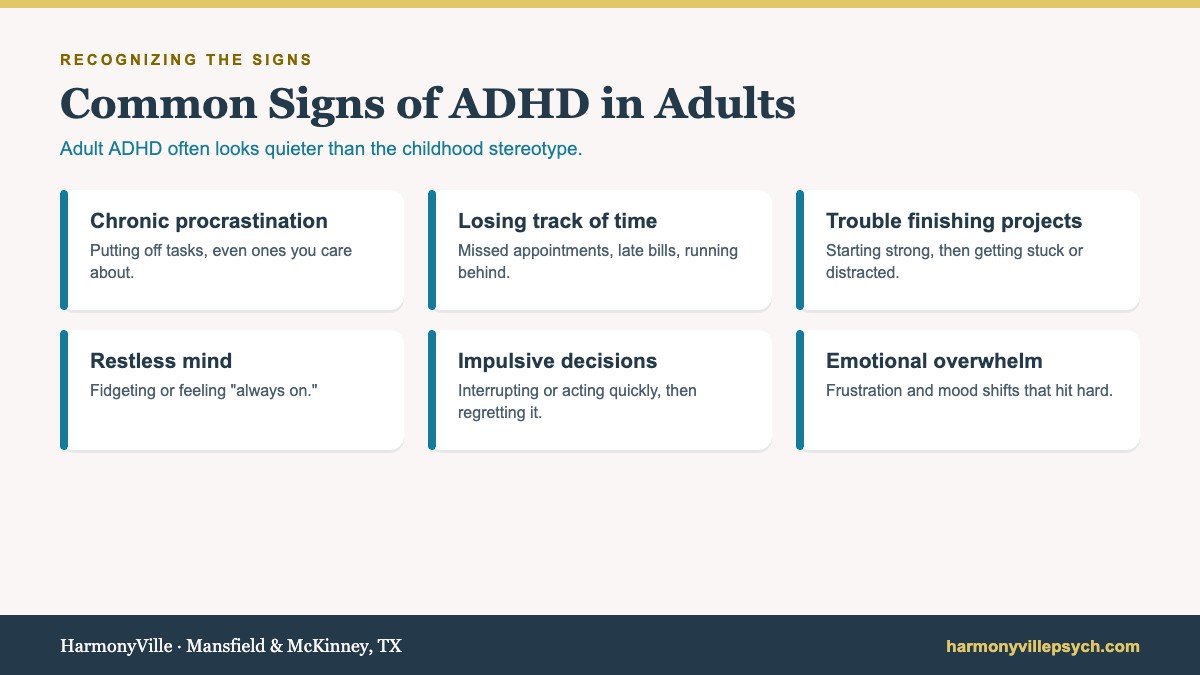
Common signs of ADHD in adults include:
- Chronic procrastination, even on tasks you care about
- Trouble starting, organizing, or finishing projects
- Losing track of time, appointments, or bills
- Restlessness, fidgeting, or an “always on” mind
- Interrupting others or making quick decisions you later regret
- Strong emotional reactions, frustration, or feeling easily overwhelmed
- Hyperfocus on interesting tasks while routine tasks pile up
Many adults with ADHD have learned to cope by working twice as hard. That can hide symptoms for years, especially in women and in people who did well in school. The National Institute of Mental Health notes that ADHD symptoms can continue into adulthood and affect work, relationships, and daily life. You can read more in the NIMH overview of ADHD.
Why a Proper Evaluation Comes First
Before choosing ADHD therapy for adults, it helps to confirm what is actually going on. Anxiety, depression, sleep problems, thyroid issues, and trauma can all look like ADHD on the surface. A careful evaluation looks at your history, current symptoms, and how they affect your life.
If you want a deeper look at diagnosis, our team also offers psychological testing that can clarify attention, memory, and mood concerns.
Common Myths About Adult ADHD
Myths keep many adults from getting help. Here are a few we hear often:
- “ADHD is just a kid thing.” Symptoms often continue into adulthood, even if they look different than they did in childhood.
- “If I can focus on video games or hobbies, I can’t have ADHD.” ADHD affects how attention is regulated, not whether you can ever focus. Hyperfocus on interesting tasks is common.
- “Successful people don’t have ADHD.” Many adults with ADHD are high achievers who work far harder than others to keep up, often at a cost to their health.
- “Treatment means medication forever.” Treatment is personal. Many people use a mix of therapy, skills, and medication, and plans change over time.
Letting go of these myths is often the first step toward seeking ADHD therapy for adults with an open mind.
How ADHD Therapy for Adults Works
ADHD therapy for adults is not about “fixing” your personality. It is about giving your brain the right tools. Most adults do best with a combination of approaches rather than a single treatment.
A good treatment plan usually addresses three areas:
- Core symptoms: focus, impulsivity, and restlessness
- Daily skills: planning, time management, and organization
- Emotional health: self-esteem, stress, and the shame many adults carry after years of struggling
Below are seven effective options for ADHD therapy for adults. Your provider can help you decide which ones fit your goals, schedule, and history.
1. Cognitive Behavioral Therapy (CBT) for Adult ADHD
Cognitive behavioral therapy is one of the most studied forms of ADHD therapy for adults. CBT for ADHD is more practical than traditional talk therapy. Sessions focus on real problems you face this week, such as a work deadline or a messy inbox.
In CBT, you and your therapist work on:
- Breaking big tasks into small, doable steps
- Using calendars, reminders, and planners consistently
- Spotting unhelpful thoughts like “I always fail, so why start?”
- Replacing avoidance with small, rewarding actions
- Building routines that reduce decision fatigue
CBT is often delivered once a week for a set number of sessions. Many adults find it especially helpful when combined with medication, because medication can make it easier to practice new skills. Learn more about our individual therapy services.
2. Medication Management
Medication is not therapy in the talk-therapy sense, but it is a central part of ADHD care for many adults. Medication can improve focus and impulse control, which makes every other form of ADHD therapy for adults easier to use.
There are two main groups of ADHD medication:
- Stimulants: These are the most commonly prescribed ADHD medications and often work quickly.
- Non-stimulants: These can be a good fit for adults who do not tolerate stimulants, have certain health concerns, or prefer a different option.
Finding the right medication and dose takes time and follow-up. A psychiatric provider will review your health history, monitor side effects, and adjust your plan as needed. Our ADHD treatment team provides ongoing medication management so you are never guessing on your own.
Is Medication Required?
No. Some adults choose therapy and skills training alone, especially when symptoms are mild. Others find medication makes a dramatic difference. The best choice depends on your symptoms, health, and personal preferences, and it is always a shared decision with your provider.
3. ADHD Coaching and Executive Function Training
Executive functions are the brain’s management skills: planning, prioritizing, remembering, and following through. ADHD affects these skills directly, so many adults benefit from structured training.
Executive function work as part of ADHD therapy for adults may include:
- Creating a simple weekly planning ritual
- Using “body doubling” or accountability check-ins
- Setting up visual systems for bills, chores, and errands
- Learning time-blocking and realistic time estimates
- Designing a workspace that reduces distraction
Coaching is forward-looking and goal-focused. It pairs well with therapy, which addresses the emotional side of living with ADHD.
4. Mindfulness-Based Therapy
Mindfulness training teaches you to notice where your attention is and gently bring it back. For adults with ADHD, this is a practical skill, not just relaxation.
Mindfulness-based ADHD therapy for adults can help with:
- Noticing distraction sooner
- Pausing before reacting impulsively
- Managing stress and racing thoughts
- Improving sleep routines
Practices can be as short as a few minutes a day. Many therapists blend mindfulness skills into CBT or dialectical behavior therapy (DBT)-informed sessions, which also target emotional regulation.
5. Emotional Regulation and Self-Esteem Work
ADHD is not only about attention. Many adults experience intense frustration, rejection sensitivity, or sudden mood shifts. After years of criticism, it is common to feel lazy, broken, or “less than.”
Therapy that focuses on emotional regulation helps you:
- Recognize emotional triggers early
- Use calming strategies in the moment
- Challenge the inner critic that formed over years of struggle
- Rebuild confidence based on your real strengths
This part of ADHD therapy for adults is often where people feel the biggest relief. Understanding that your struggles have a reason, and are not a character flaw, can be life-changing.
6. Couples and Family Therapy
ADHD affects everyone in a household. Missed plans, forgotten chores, and impulsive spending can create tension with partners and family members. Over time, one partner may feel like a parent, and the other may feel constantly criticized.
Couples or family sessions can help by:
- Educating loved ones about how ADHD works
- Reducing blame and repeated arguments
- Dividing responsibilities in a fair, ADHD-friendly way
- Improving communication and follow-through
Bringing your partner into ADHD therapy for adults can turn frustration into teamwork.
7. Group Therapy and Peer Support
Sometimes the most powerful moment in treatment is realizing other people think the way you do. Group settings offer practical tips, shared strategies, and a sense of belonging.
Group-based ADHD therapy for adults can be a cost-effective way to practice skills and stay accountable. Explore our group therapy options to see what is currently available.
Treating ADHD Alongside Anxiety and Depression
Adult ADHD rarely shows up alone. Anxiety, depression, and sleep problems are common companions. Sometimes years of unmanaged ADHD lead to chronic stress and low mood.
That is why a whole-person approach matters. Effective ADHD therapy for adults looks at the full picture, not just attention. If anxiety or low mood is part of your story, our providers can address both together. You can learn more about our anxiety treatment and depression treatment services.
Daily Habits That Support ADHD Therapy for Adults
Treatment works best when it is supported by small, steady habits outside the therapy room. You do not need a perfect routine. You need a few simple anchors that make your day more predictable.
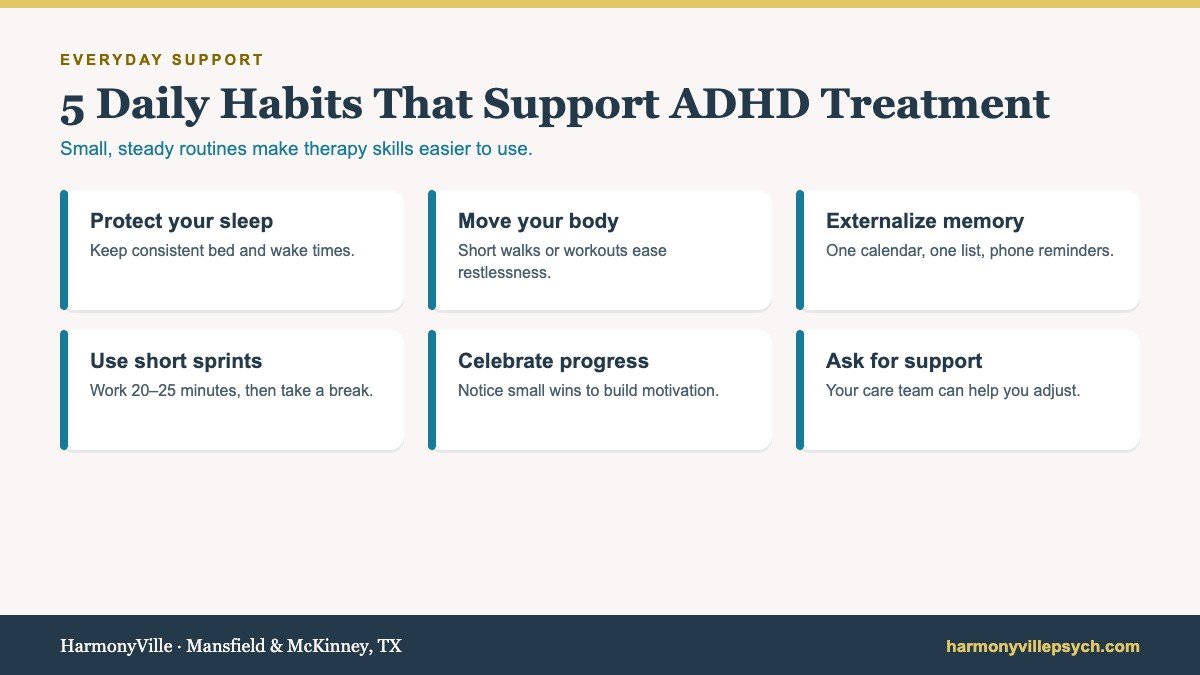
Protect Your Sleep
Poor sleep makes focus, mood, and impulse control harder for everyone, and especially for people with ADHD. Aim for a consistent bedtime and wake time, limit screens late at night, and keep caffeine to earlier in the day. If you struggle to fall asleep or wake up, mention it to your provider, since sleep and ADHD often affect each other.
Move Your Body
Regular physical activity can boost mood, ease restlessness, and make it easier to settle into focused work. A brisk walk, a short workout, or even stretching between tasks can help. Choose movement you enjoy so it is easier to repeat.
Externalize Your Memory
ADHD makes it hard to hold information in your head. Instead of relying on memory, put it outside your brain. Use one calendar, one task list, and phone reminders for anything time-sensitive. Keep keys, wallet, and other daily items in a single “launch pad” spot near the door.
Use Short Work Sprints
Long stretches of focus can feel impossible. Try working in short sprints, such as 20 to 25 minutes, followed by a brief break. Timers make time visible and help you start, which is often the hardest part.
Celebrate Progress, Not Perfection
Adults with ADHD are often very hard on themselves. Notice what is working, even small wins. Positive feedback builds motivation, and motivation is fuel for the ADHD brain. Your therapist can help you track progress so you see how far you have come.
These habits do not replace professional care. They make the tools you learn in ADHD therapy for adults easier to use every day.
Signs It May Be Time to Seek Help
Many adults wait years before reaching out because they assume their struggles are normal or a personal weakness. Consider talking with a provider if you notice that:
- You are falling behind at work or school despite real effort
- Late payments, missed appointments, or lost items are causing stress
- Relationships are strained by forgetfulness or impulsive reactions
- You feel constantly overwhelmed, anxious, or down about yourself
- Coping strategies that once worked are no longer enough
- Your child was recently diagnosed with ADHD and you recognize the same traits in yourself
Reaching out is not a sign of failure. It is a practical step toward a calmer, more organized life. Starting ADHD therapy for adults earlier can prevent years of unnecessary frustration.
How to Choose the Right ADHD Therapy for Adults
With so many options, it is normal to feel unsure where to begin. These questions can help guide the conversation with your provider:
- What is hurting most right now? Work performance, relationships, finances, or mood?
- Have you tried medication before? What helped and what did not?
- How much time can you commit? Weekly therapy, short-term skills training, or occasional check-ins?
- Do you prefer in-person or telehealth visits?
- Are other conditions involved? Such as anxiety, depression, or sleep issues?
The best ADHD therapy for adults is the one you can stick with. A good provider will build a plan around your real life, not an ideal one.
What to Expect at Your First Visit
Your first appointment is a conversation, not a test you can fail. A provider will ask about:
- Your current symptoms and when they started
- School and work history
- Family history of ADHD or other mental health conditions
- Sleep, mood, substance use, and overall health
- Your goals for treatment
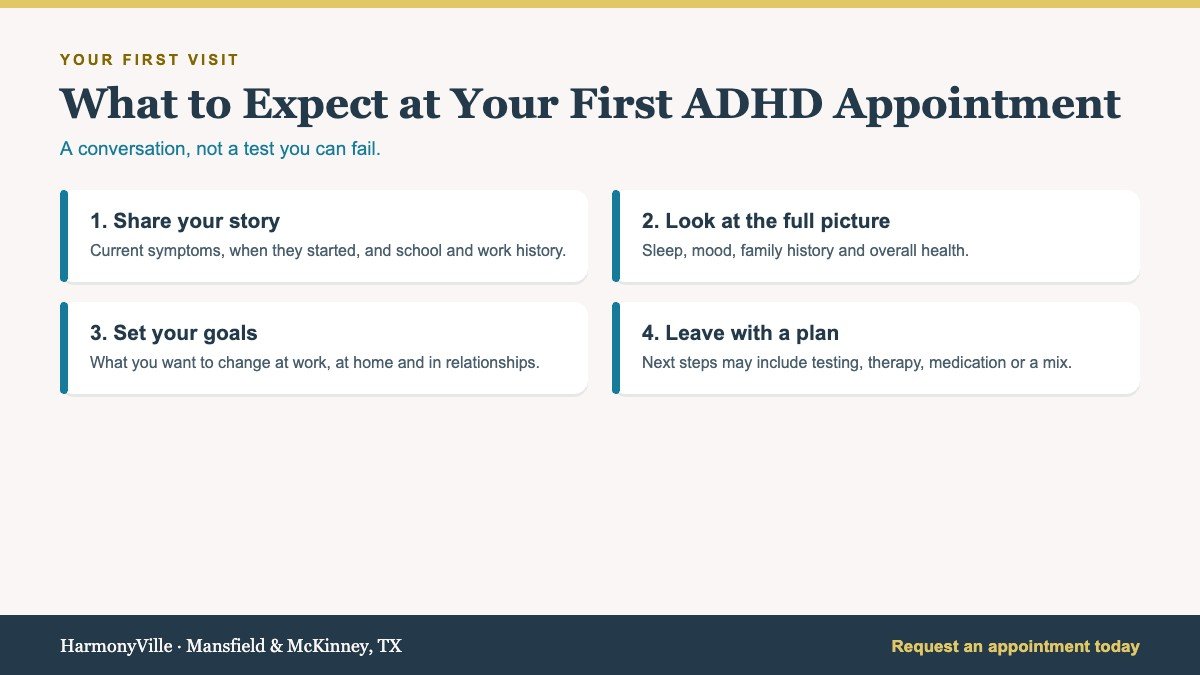
From there, your provider may recommend further testing, start a treatment plan, or both. You will leave with clear next steps.
ADHD Therapy for Adults in Mansfield and McKinney, TX
HarmonyVille provides compassionate, evidence-based care for adults with ADHD at our Mansfield and McKinney offices. Our team includes psychiatrists, psychiatric nurse practitioners, and therapists who work together on your plan.
When you choose HarmonyVille for ADHD therapy for adults, you can expect:
- A thorough evaluation that looks beyond attention alone
- Personalized treatment that may combine therapy, skills training, and medication
- Ongoing follow-up so your plan adjusts as your life changes
- A respectful, judgment-free space
We also understand that adults with ADHD are busy and often juggling careers, families, and school. Our team works to keep scheduling simple, communicate clearly between visits, and make sure you always know what comes next in your care. Whether you are newly diagnosed or have managed ADHD for years, we meet you where you are and help you move forward at a pace that feels manageable.
Visit our Mansfield, TX office or our McKinney, TX office pages to learn more about each location.
Frequently Asked Questions About ADHD Therapy for Adults
Can adults be diagnosed with ADHD for the first time?
Yes. Many adults are diagnosed in their 20s, 30s, 40s, or later. Symptoms usually began in childhood but may have been missed, especially if you did well in school or developed strong coping habits. A qualified provider can evaluate your history and current symptoms.
What is the most effective ADHD therapy for adults?
There is no single best option for everyone. Research supports cognitive behavioral therapy and medication as core treatments, and many adults do best with both. Skills training, coaching, and mindfulness can add extra support. Your provider will help match treatment to your needs.
How long does ADHD therapy for adults take to work?
It varies. Some adults notice changes within a few weeks of starting medication. Therapy skills often build over several months of consistent practice. Think of treatment as a process, with regular check-ins to measure progress and adjust the plan.
Can I get ADHD therapy without medication?
Yes. Therapy, coaching, and lifestyle strategies can help many adults, especially those with milder symptoms or who prefer not to take medication. A provider can talk through the pros and cons of each path with you.
Does insurance cover ADHD therapy for adults?
Many insurance plans cover ADHD evaluation, therapy, and medication management, but benefits vary by plan. Our front office team can help you check your coverage before your first visit so there are no surprises.
Is telehealth available for adult ADHD treatment?
Many follow-up and therapy visits can be done by telehealth, which makes it easier to stay consistent with a busy schedule. Ask our team which visits can be virtual and which should be in person.
Take the First Step Toward Feeling in Control
Living with untreated ADHD can feel exhausting, but help is available and it works. You do not need to keep pushing through on willpower alone. ADHD therapy for adults can help you focus, follow through, and feel more confident in every part of your life.
Ready to talk with a specialist? Request an appointment at our Mansfield or McKinney office today, or call Mansfield at 682-341-3040 or McKinney at 682-708-2797. Our team will help you find the right plan for your goals.