It’s Sunday night. The laptop is closed, but your chest is already tight thinking about Monday. You slept nine hours on Saturday and still woke up tired. Maybe you’ve wondered, more than once, whether this is just burnout or something heavier. That question, burnout vs depression, comes up in our Mansfield and McKinney offices almost every week, and it’s a fair one. The two overlap a lot. But they aren’t the same thing, and the difference matters for what actually helps.
This guide walks through how each one shows up, seven practical ways to tell them apart, and what to do if you’re not sure which one you’re dealing with. (Spoiler: you don’t have to figure that out alone.)
Table of Contents
Burnout vs Depression: Why They’re So Easy to Mix Up
On paper, they look like cousins. Both can leave you exhausted. Both can make you irritable, foggy, and short with the people you love. Both can wreck your sleep and make the smallest task feel like climbing a hill in wet clothes.
So it’s no surprise that people use the words interchangeably. You’ll hear someone say “I’m so burned out” when they mean they’ve felt empty for months, and you’ll hear someone call it “just stress” when it’s actually depression that’s been building quietly for a year.
Here’s the simplest way we explain burnout vs depression to patients. Burnout is usually about something. Depression is often about everything.
That one line doesn’t cover every case, but it’s a good place to start.
What Burnout Actually Is
Burnout isn’t a formal mental health diagnosis. The World Health Organization describes it as an occupational phenomenon that comes from chronic workplace stress that hasn’t been successfully managed. In its definition, burnout has three parts:
- Exhaustion. You feel drained, depleted, running on fumes.
- Mental distance from your job. Cynicism, negativity, or a “why bother” attitude toward work you used to care about.
- Reduced effectiveness. You’re working just as hard (or harder) and getting less done.
Notice how tied to work all three are. Strictly speaking, the WHO definition applies to the job. In real life, though, people burn out from caregiving, from parenting a child with high needs, from nursing school, or from carrying a family business. The pattern is the same: a specific load, carried too long, without enough recovery.
What Depression Looks Like
Depression is a medical condition, and it doesn’t stay in one lane. Clinicians look for a cluster of symptoms that last most of the day, nearly every day, for at least two weeks. According to the National Institute of Mental Health, those can include:
- A persistent sad, anxious, or “empty” mood
- Losing interest or pleasure in things you used to enjoy
- Feelings of guilt, worthlessness, or hopelessness
- Changes in sleep or appetite
- Trouble concentrating or making decisions
- Moving or talking more slowly, or feeling restless
- Thoughts of death or suicide
The big difference in burnout vs depression? Depression follows you home. It shows up on vacation. It sits with you at your kid’s soccer game and at dinner with friends. Taking a week off rarely fixes it, because the job was never the whole story.
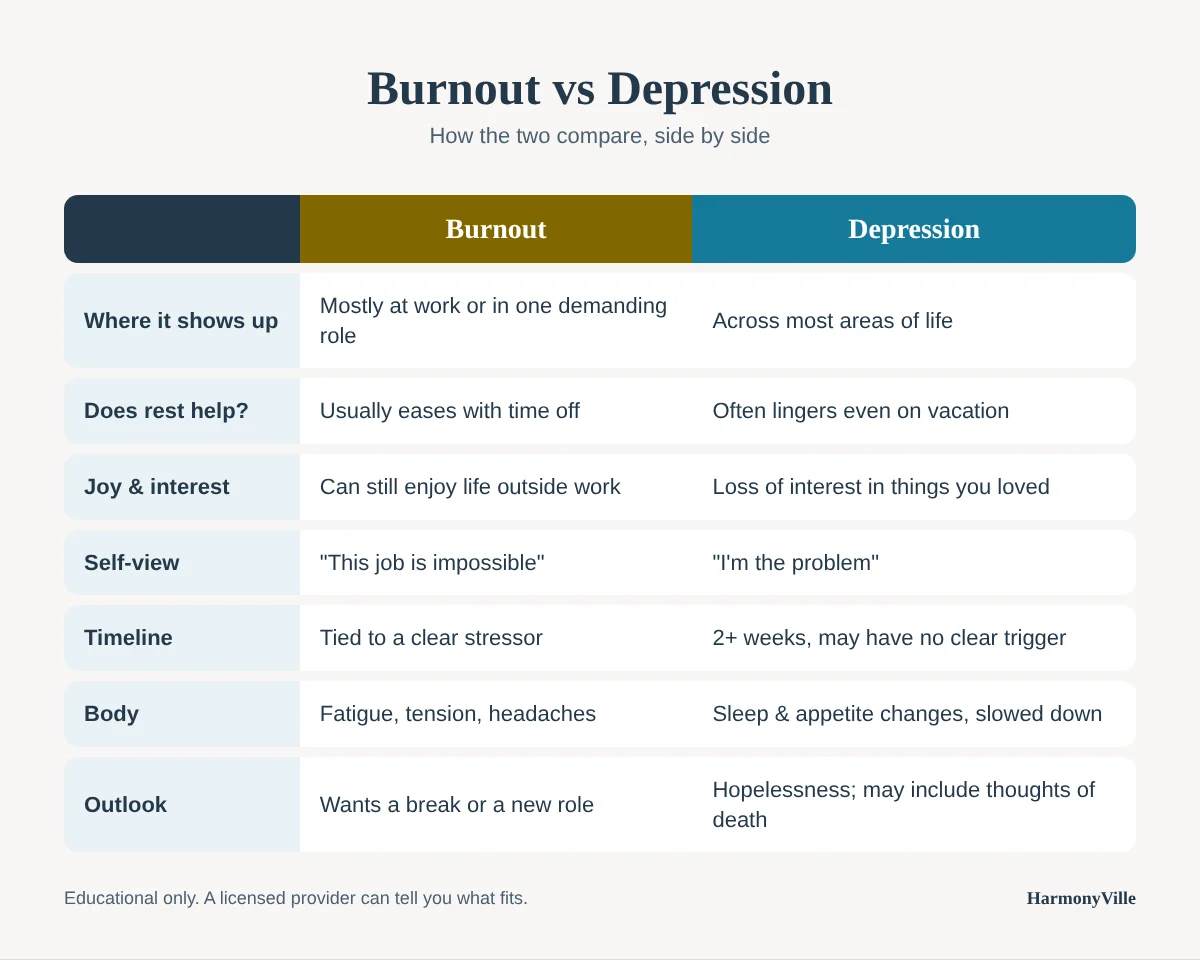
Burnout vs Depression at a Glance
If you only have a minute, here’s the short version of burnout vs depression:
- Burnout is a response to a specific, ongoing source of stress, most often work. It usually improves when the pressure lifts or you get real rest.
- Depression is a mood disorder that colors most of your life. It tends to stick around even when the stress is gone, and it often needs professional treatment to lift.
The chart above sums it up, but the details below are where most people recognize themselves.
Burnout vs Depression: 7 Key Differences
No burnout vs depression checklist can diagnose you, and many people have a bit of both. Still, these seven differences tend to point in one direction or the other.
1. Where the heaviness lives
With burnout, the dread usually attaches to a specific place or role. You feel it pulling into the office parking lot or opening your inbox. Away from that, you might feel close to normal. With depression, the low mood tends to spread across your whole life, not just your work.
2. Whether rest helps
This is one of the clearest clues in the whole burnout vs depression puzzle. A long weekend, a real vacation, or a few lighter weeks will often take the edge off burnout. Depression doesn’t respond that way. People with depression often tell us the vacation was “fine” but they couldn’t enjoy it, or they felt just as flat by day two.
3. Whether you can still feel joy
Burned-out people can usually still laugh at a good movie, enjoy a meal with friends, or get excited about a trip. Depression tends to dull those things too. Clinicians call this anhedonia: the color draining out of things that used to feel good.
4. How you see yourself
Burnout tends to aim the frustration outward. “This job is impossible.” “Nobody here cares.” Depression often turns it inward. “I’m the problem.” “I’m letting everyone down.” “What’s the point of me?” If your inner voice has gotten harsh and personal, that’s worth paying attention to.
5. How it started and how long it’s lasted
Burnout usually has a clear storyline. A new manager, a promotion with twice the workload, a staffing shortage that never ended. Depression can have a trigger too, but sometimes it shows up without a clear reason, and it can linger even after life gets easier.
6. What your body is telling you
Both can cause headaches, stomach trouble, and tension. Depression is more likely to bring real shifts in appetite and weight, sleeping far more or far less than usual, and a heavy, slowed-down feeling that has nothing to do with how busy you are.
7. Hopelessness and thoughts of death
Burnout can make you want to quit your job. Depression can make you feel like there’s no way forward at all. Thoughts that people would be better off without you, or that you’d like to not wake up, are not a burnout symptom. They’re a sign to reach out for help right away. If you’re there right now, call or text 988 to reach the Suicide & Crisis Lifeline, or call 911.
Can Burnout Turn Into Depression?
It can, and this is where the burnout vs depression question gets less tidy. When chronic stress goes on for months without relief, it can wear down the systems that regulate mood, sleep, and energy. What started as “I hate this job” can slowly become “I hate everything, including me.”
Research continues to explore exactly how much the two overlap, and experts don’t fully agree on where one ends and the other begins. What we see in practice is simpler: people often wait until burnout has already slid into something deeper before they ask for help. You don’t need to wait for things to get that bad.
Why Getting the Burnout vs Depression Answer Right Matters
You might be thinking, “Does the label really matter if I feel awful either way?” Fair question. It matters because burnout vs depression calls for different fixes.
If it’s burnout, the most useful changes are often around the source: workload, boundaries, a frank talk with your manager, sometimes a role change. Therapy helps you make those changes without guilt. If it’s depression, a vacation and a new planner won’t be enough. Depression is treatable, and many people improve with therapy, medication, or both, but it usually needs that kind of care.
Getting it wrong can cost months. People with depression sometimes switch jobs, feel the same in the new one, and decide the problem must be them. People with burnout sometimes worry they’re “broken” when what they really need is a lighter load and some recovery time. A clear assessment saves you from both.
What burnout vs depression looks like for parents and caregivers
Not all burnout comes with a paycheck. We see a lot of parents in Mansfield and McKinney who are running a household, a career, and a kid’s therapy schedule all at once. Caregiver burnout often sounds like, “I love my family, I just have nothing left.” That’s different from losing the ability to feel love or pleasure at all, which leans more toward depression. If you’re not sure which side of that line you’re on, it’s a great thing to bring to a first appointment.
A Quick Self-Check: Which One Sounds More Like You?
Try answering these honestly, without worrying yet about the burnout vs depression label. It’s not a burnout vs depression test, just a way to notice patterns.
- If you took two weeks fully off, do you think you’d feel noticeably better?
- Are there parts of your life (friends, hobbies, weekends) that still feel good?
- Is your frustration mostly about your workload, or mostly about yourself?
- Have you felt this way for more than two weeks, most days?
- Has your sleep or appetite changed in a way that worries you?
Mostly “yes” to the first three? That leans toward burnout. More “yes” to the last two, or a gut feeling that rest wouldn’t touch it? That leans toward depression. Either way, a conversation with a professional will tell you far more than any list on the internet, including this one.
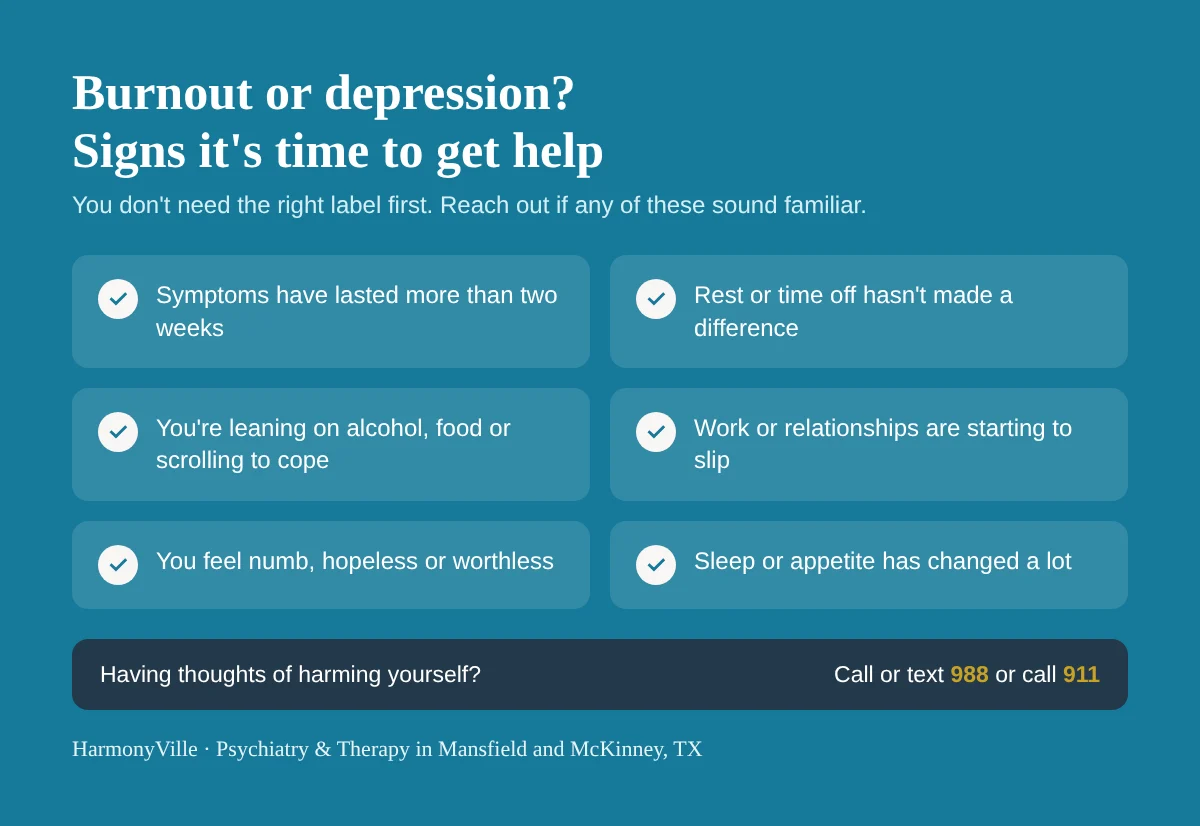
Signs It’s Time to Talk to a Professional
You don’t need to settle the burnout vs depression question before booking an appointment. Sorting that out is literally our job. That said, these are good reasons to reach out sooner rather than later:
- Symptoms have lasted more than two weeks and aren’t easing up
- Rest, time off, or setting boundaries hasn’t helped
- You’re using alcohol, food, or scrolling to get through the day
- Your relationships or performance are starting to slip
- You feel hopeless, worthless, or numb
- You have any thoughts of harming yourself
Burnout can also travel with anxiety: racing thoughts, a pounding heart before meetings, trouble switching off at night. If that sounds familiar, our page on adult anxiety treatment is a helpful next read.
How HarmonyVille Helps With Burnout and Depression
At HarmonyVille, we start by listening. Your first visit is a conversation about what’s been going on, how long it’s been happening, and how it’s affecting your sleep, your work, and the people around you. From there, your provider helps you work through the burnout vs depression question (one, the other, or a mix of both) and what to do next.
Depending on what’s going on, your plan might include:
- Therapy. For burnout, therapy helps you untangle the stress, rebuild boundaries, and make real decisions about work. For depression, approaches like CBT can shift the thought patterns that keep you stuck. Learn more about individual therapy at HarmonyVille.
- Psychiatric care and medication management. If depression is part of the picture, a psychiatric provider can talk with you about whether medication makes sense, and adjust it carefully over time. See our depression treatment page for more.
- Practical support. Help with sleep, routines, and conversations about workload or leave when it’s appropriate.
If getting to an office feels like one more thing on a full plate, many visits can happen by video. Here’s how telehealth psychiatry in Texas works with our team. And if you’ve been told you seem “fine” while struggling inside, you might also relate to our guide on high-functioning depression.
What to expect at your first visit
A lot of people put off booking because they’re not sure what happens next. It’s pretty low-key. You’ll talk about your symptoms, your work and home life, your sleep, and any history of anxiety or depression in you or your family. You might fill out a short questionnaire. Nobody expects you to show up with a diagnosis or the perfect words. “I can’t tell if this is burnout vs depression, and I’m tired of feeling this way” is a completely good opening line. By the end, you’ll have a clearer picture and a next step, whether that’s therapy, a medication conversation, or simply a plan to recover.
Small Things You Can Start This Week
Whatever the answer to burnout vs depression turns out to be, small changes can buy you some breathing room while you get professional care:
- Protect one hour a day that has nothing to do with work. No email, no “quick check.”
- Notice what drains you and what refuels you. Write it down for a week. Patterns show up fast.
- Move your body, even a little. A 15-minute walk after work is enough to start.
- Say one thing out loud. Tell a friend, partner, or coworker, “I’m not doing great.” Saying it changes how heavy it feels.
- Keep your sleep and wake times steady, even on weekends.
These won’t fix depression on their own, and that’s okay. They’re a bridge, not a cure.
Frequently Asked Questions About Burnout vs Depression
How do I know if it’s burnout or depression?
The quickest way to sort out burnout vs depression is to look at where the symptoms show up and whether rest helps. Burnout tends to center on work or one demanding role and eases with time off. Depression tends to affect your whole life, including things you used to enjoy, and lasts two weeks or more. A provider can help you sort it out.
Is burnout a mental illness?
Not officially. The WHO classifies burnout as an occupational phenomenon, not a medical condition. But untreated burnout can raise the risk of anxiety and depression, so it still deserves real attention. That’s one of the biggest burnout vs depression distinctions: depression is a diagnosable condition, burnout is not.
Can a psychiatrist help with burnout?
Yes. A psychiatric provider can check whether depression, anxiety, or a sleep problem is driving how you feel, and build a plan that may include therapy, lifestyle changes, or medication if it’s needed.
Can you have burnout and depression at the same time?
Yes, and it’s common. Long-term burnout can wear you down until depression sets in, and depression can make an ordinary workload feel crushing. When it’s both, treatment usually addresses the stress and the mood together.
Should I quit my job if I’m burned out?
Not necessarily, and it’s best not to make that call while you’re running on empty. Many people recover by changing workload, boundaries, or expectations. Talking it through with a therapist first can help you decide with a clear head.
Talk to Someone Who Gets It
You’ve been carrying this for a while. Whether it turns out to be burnout, depression, or a little of both, you deserve to feel like yourself again. Our team in Mansfield and McKinney, TX sees people every week who walked in unsure and walked out with a plan.
Book a visit today, or call the office closest to you.
This article is for educational purposes and isn’t a substitute for professional medical advice. If you’re in crisis, call or text 988 or call 911.