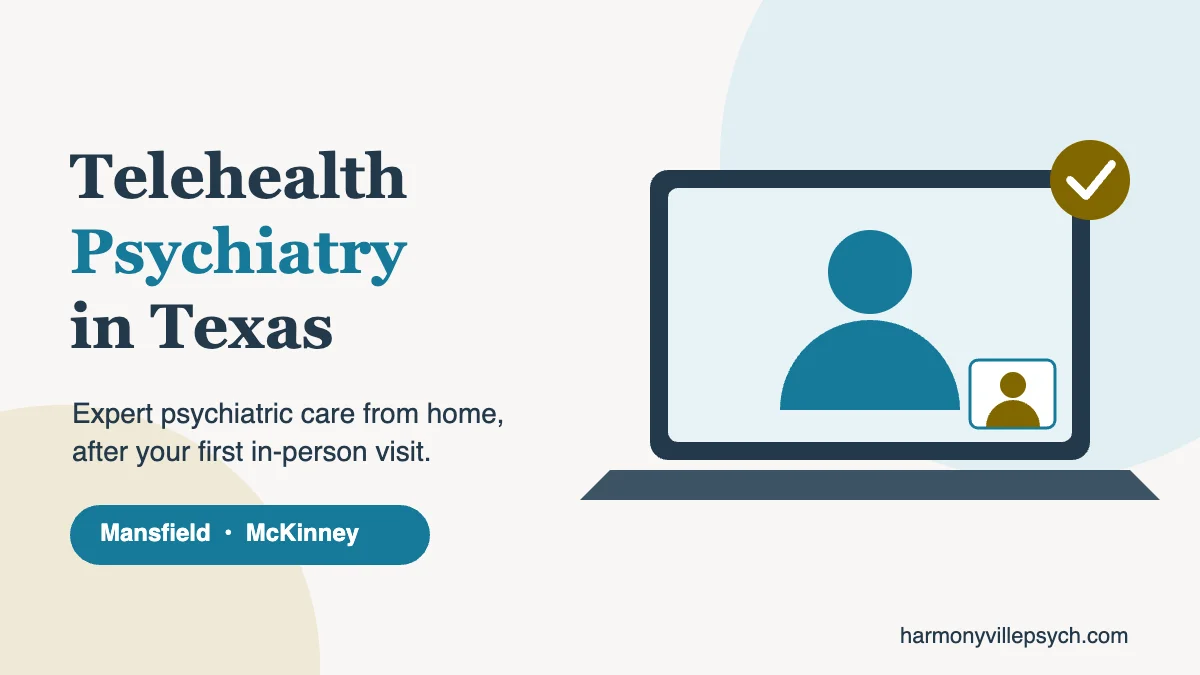
Telehealth psychiatry lets you meet with a licensed psychiatric provider over a secure video link instead of sitting in a waiting room. For many Texans juggling long commutes, packed work schedules, or a teenager’s after-school calendar, that one change is often the difference between keeping a follow-up appointment and quietly letting it slide. At HarmonyVille, telehealth psychiatry is available to patients anywhere in Texas once their first evaluation is complete at our Mansfield or McKinney clinic.
Virtual care also raises fair questions. Is it as effective as an office visit? What can a provider really do over video? Will insurance cover it? This guide explains how telehealth psychiatry works, who it suits best, what still needs an in-person visit, and seven easy steps to get the most out of every appointment.
Table of Contents
What Is Telehealth Psychiatry?
Telehealth psychiatry is psychiatric care delivered through live, two-way video. During a session, your provider can review your symptoms, talk through how a medication is working, adjust a dose, coordinate therapy, and update your treatment plan. That is the same core work that happens in an exam room, just without the drive.
You may also hear it called virtual psychiatry, online psychiatry, or telepsychiatry. Whatever the label, the clinical standard should not change. You are seeing a licensed clinician who keeps a medical record, follows your progress over time, and can coordinate with your other care.
What it is not: a chat app, an anonymous text line, or a one-time prescription service. Good telehealth psychiatry is ongoing, relationship-based care that happens to take place on a screen.
Telehealth Psychiatry vs. Online Therapy Apps
Many people first meet “virtual mental health” through subscription therapy apps. Those apps usually connect you with a counselor for talk therapy only. Telehealth psychiatry is different because it includes medical evaluation and medication management by a psychiatric prescriber, such as a psychiatrist or a psychiatric nurse practitioner, alongside therapy when it helps.
That distinction matters if you are living with depression, anxiety, ADHD, bipolar disorder, or PTSD. These conditions often respond best to a combined plan, where medication, therapy, and lifestyle changes are adjusted together by a team that knows your history.
Does Telehealth Psychiatry Work as Well as In-Person Care?
For many people and many conditions, the answer is yes. Research on telepsychiatry has generally found that video visits can be as effective as office visits for follow-up care and medication management, with similar levels of patient satisfaction. Federal health agencies now treat telehealth as a mainstream way to receive care, and the U.S. Department of Health and Human Services telehealth guide offers helpful background for patients.
The biggest advantage is often consistency. Mental health treatment tends to work best when appointments happen on schedule and small problems get caught early. When a visit costs you an afternoon of driving, parking, and waiting, it is easy to postpone. When it costs you thirty minutes at your kitchen table, you are far more likely to show up.
That said, video is not the right tool for every situation. A thoughtful practice will tell you clearly what works well virtually and what still needs a room.
What Telehealth Psychiatry Handles Well
- Medication follow-ups: reviewing how you are responding, checking side effects, and adjusting doses.
- Individual therapy: weekly or biweekly sessions with the full fifty minutes, from home. Learn more about our individual therapy services.
- Adolescent care: check-ins that fit around school, sports, and activities.
- Family check-ins: parents can join from different locations in the same session.
- Brief consultations: short visits between appointments when something changes.
What Still Needs an In-Person Visit
- Your first psychiatric evaluation, which is completed at our Mansfield or McKinney clinic.
- Ketamine therapy, which is provided in the clinic only.
- TMS therapy, which requires in-office treatment sessions.
- Psychological testing and some evaluations for younger children.
You can see the full list of virtual services on our HarmonyVille telehealth page.
Who Is a Good Fit for Telehealth Psychiatry?
Telehealth psychiatry works well for a wide range of patients. You may be an especially good fit if you recognize yourself in one of these situations:
- Working adults with tight schedules who cannot keep losing half a day to appointments.
- Parents of teens who want care that does not pull their child out of school.
- Texans in rural or outlying areas where the nearest psychiatric provider is an hour or more away.
- College students living in another part of Texas during the semester.
- People on a stable medication plan who need regular monitoring rather than frequent hands-on exams.
- People for whom leaving the house is part of what they are working on, such as those managing anxiety or depression.
When Virtual Care Is Not the Right Fit
Telehealth is designed for scheduled, ongoing care. It is not a crisis service. If you or someone you love is thinking about suicide or is in immediate danger, call or text the 988 Suicide & Crisis Lifeline or call 911 right away.
Virtual care may also be a poor fit if you do not have a private place to talk, if your symptoms need closer in-person monitoring, or if your provider recommends a higher level of care. Your clinician will be honest with you about which setting gives you the best chance of feeling better.
Conditions Commonly Managed With Telehealth Psychiatry
Once your initial evaluation is complete, many common mental health conditions can be managed well through a mix of in-person and virtual visits. Here is how telehealth psychiatry often fits into care for the conditions we see most.
Anxiety Disorders
Generalized anxiety, social anxiety, and panic disorder often involve regular medication check-ins and therapy. For some patients, joining from home removes one of the biggest barriers to treatment, which is the stress of getting to the appointment itself. Learn more about our anxiety disorder treatment.
Depression
Depression can drain the energy it takes to drive across town, which is exactly why steady follow-ups matter. Virtual visits make it easier to track mood changes, adjust medication, and stay connected during harder weeks. Explore our approach to depression treatment.
ADHD
Adults and teens with ADHD often benefit from regular reviews of focus, sleep, appetite, and side effects. Video visits can fit around a workday or school schedule. Some ADHD medications follow stricter prescribing rules, so your provider will explain when an in-person visit is required.
Bipolar Disorder and PTSD
Bipolar disorder and PTSD usually call for close, consistent monitoring. Telehealth can make it easier to keep appointments on track, while your provider schedules in-person visits whenever closer evaluation is needed.
7 Easy Steps to Get Started With Telehealth Psychiatry
Starting telehealth psychiatry at HarmonyVille is simple. Here is what the process looks like from your first call to your ongoing follow-ups.
Prefer to watch on YouTube? Watch the full HarmonyVille telehealth walkthrough on YouTube.
Step 1: Request Your Appointment
Book online through our appointment request form or call the clinic closest to you. Let our team know you are interested in virtual follow-ups so we can plan your care with that in mind. You will receive a confirmation with the date, time, and instructions for your first visit.
Step 2: Complete Your Initial In-Person Evaluation
Your first psychiatric appointment takes place in person at our Mansfield or McKinney clinic. This visit gives your provider time to understand your history, symptoms, goals, and any medications you already take. It also lets us complete insurance steps and any required clearances. If you feel nervous about this first appointment, our guide on what to expect at your first psychiatric visit walks you through it.
Step 3: Verify Insurance and Finish Paperwork
Before your visit, our team verifies your insurance benefits and reviews any copay, deductible, coinsurance, or self-pay costs with you. We also send easy-to-complete new patient forms. Finishing these ahead of time means more of your appointment is spent on care instead of clipboards.
Step 4: Prepare Your Space and Technology
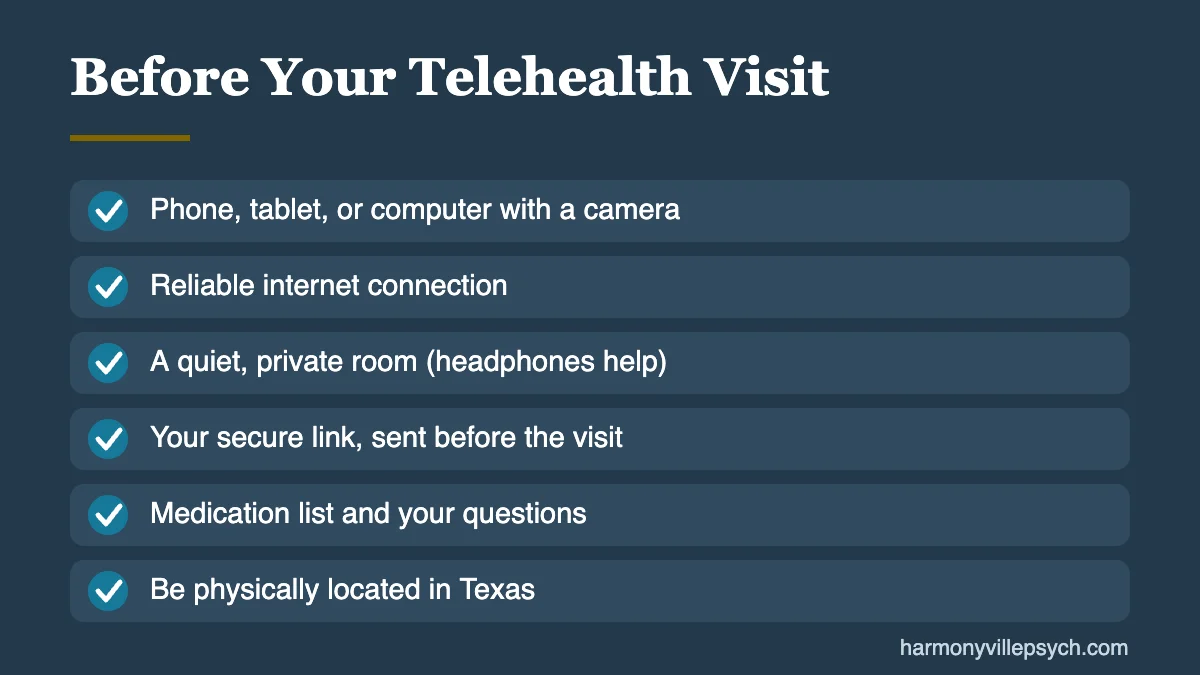
For telehealth psychiatry follow-ups, you need a phone, tablet, or computer with a camera, a reliable internet connection, and a private space. There is no app to download and no account to create. Choose a quiet room where you can speak openly, and consider headphones if others are home.
Step 5: Join Your Secure Video Visit
Before each follow-up, we send you a secure link. A few minutes before your appointment, open the link, check your camera and microphone, and wait for your provider to join. At the start of the session, confirm where you are physically located. Your clinician must be licensed in the state where you are during the visit, so you will need to be in Texas.
Step 6: Work Through Your Personalized Care Plan
Your provider will tailor your treatment plan to your needs. That plan may include psychiatric medication management, therapy recommendations, lifestyle guidance, or referrals. Telehealth psychiatry visits are a good time to share what has improved, what has not, and any side effects, even ones that feel minor.
Step 7: Keep Your Follow-Ups Consistent
Progress in mental health care usually comes from steady, regular check-ins rather than one big appointment. Before you log off, schedule your next telehealth follow-up so it is already on the calendar. If you are unsure how often you should be seen, read our article on how often you should see a psychiatrist.
How to Get the Most Out of Every Virtual Visit
A little preparation makes a big difference. Patients who come to telehealth psychiatry appointments ready with notes tend to get more out of the time. Try these simple habits:
- Track your symptoms between visits. A few words a day about mood, sleep, energy, and focus help your provider spot patterns.
- Write down your questions. It is easy to forget them once the call starts.
- Keep your medication bottles nearby. Your provider may ask about exact doses or refill dates.
- Be honest about side effects. Many side effects can be eased with a dose change or a different medication.
- Use headphones for privacy. You will feel freer to speak openly.
- Give yourself a buffer. Leave five or ten minutes after the session to reflect before jumping back into work.
For a printable list of what to prepare, see our psychiatric appointment checklist.
Is Telehealth Psychiatry Covered by Insurance in Texas?
Most insurance plans that HarmonyVille accepts cover telehealth psychiatry in a similar way to an office visit. We work with major insurers including Aetna, Blue Cross Blue Shield, Cigna, UnitedHealthcare, Medicaid, Medicare, and others. Because every plan is a little different, we verify your benefits before your first appointment so there are no surprises.
You can review accepted plans and payment options on our insurance and costs page. If you have a question about a specific copay or deductible, our front desk team is happy to help.
Texas Licensing Rules for Virtual Visits
Because your clinician must be licensed in the state where you are physically located during the session, you need to be in Texas for each telehealth visit. The good news is that you do not have to live near a clinic. Whether you are in Fort Worth, Austin, Houston, or a small town in West Texas, you can continue your follow-ups virtually. If you will be traveling out of state on your appointment day, call us so we can reschedule.
Telehealth Psychiatry for Teens and Children
Telehealth is often a great option for families. Teenagers can attend sessions around school and activities, and many teens feel more relaxed talking from a familiar space. For children, a parent is usually present for at least part of the session. Some evaluations for younger children are better done in person, and our team will tell you which applies to your child.
A few small steps help virtual visits go smoothly for families. Set up the device in a room where your teen can speak privately for part of the session. Agree ahead of time on when a parent will join the conversation. Keep a short list of changes you have noticed at home or school, such as sleep, grades, appetite, or friendships, so the provider gets a full picture in the time available.
If your family is exploring care for a child or teen, visit our child and adolescent psychiatry page to learn how our providers support young patients and their parents.
Privacy and Security in Virtual Psychiatric Care
Privacy is one of the most common concerns we hear, and it is a reasonable one. HarmonyVille telehealth visits run through a secure video platform built for healthcare, connected to your medical record. You join through a private link sent before each visit, so there is no public profile and no account to manage.
You can protect your privacy on your end, too. Choose a room with a door, use headphones, and avoid public Wi-Fi when possible. If someone walks in during your session, it is completely fine to pause and tell your provider you need a moment.
Frequently Asked Questions About Telehealth Psychiatry
Do I need to visit the clinic before my first telehealth psychiatry appointment?
Yes. At HarmonyVille, your first psychiatric evaluation takes place in person at our Mansfield or McKinney clinic. This lets your provider complete a thorough assessment along with any insurance steps or required clearances. After that, many follow-up appointments can be completed through telehealth when your provider agrees it is appropriate.
Can a psychiatric provider prescribe medication through telehealth in Texas?
In many cases, yes. Providers can review how a medication is working, adjust doses, and manage prescriptions during telehealth follow-ups. Some medications, including certain controlled substances such as those used to treat ADHD, have additional federal and state rules. Your provider will explain what applies to your specific treatment plan.
What do I need for a telehealth psychiatry visit?
You need a phone, tablet, or computer with a camera, a reliable internet connection, and a private, quiet space. We send a secure link before each appointment, so there is no app to download and no account to set up.
Can I have a telehealth visit if I am traveling outside Texas?
Your clinician must be licensed in the state where you are physically located during the session. If you will be outside Texas on your appointment day, please call our office so we can reschedule your visit for a time when you are back in the state.
Is telehealth psychiatry appropriate during a mental health crisis?
No. Telehealth psychiatry is designed for scheduled, ongoing care. If you or someone you love is in crisis or thinking about suicide, call or text 988 to reach the Suicide and Crisis Lifeline, or call 911 for immediate help.
Start Telehealth Psychiatry With HarmonyVille
You should not have to choose between your schedule and your mental health. With telehealth psychiatry, you can keep moving forward with expert care from home, while knowing our Mansfield and McKinney clinics are there whenever an in-person visit is the better choice.
Ready to take the first step? Request an appointment online today, or call our Mansfield office at (682) 341-3040 or our McKinney office at (682) 708-2797. Our team will help you schedule your first evaluation and set up virtual follow-ups that fit your life.
This article is for educational purposes only and is not a substitute for professional medical advice, diagnosis, or treatment. If you are in crisis, call or text 988 or call 911.