What to expect at your first psychiatric visit is important to understand – A first psychiatric visit is an evaluation, not treatment. Expect 45 to 60 minutes covering your symptoms, history, medications, and safety, followed by a working diagnosis and a plan. Medication may or may not be started on that day.
You have had the number saved in your phone for two months. The appointment is Thursday, and somewhere between now and then you are going to try to talk yourself out of it — because you do not actually know what happens once you sit down.
So here is the whole thing, start to finish. Understanding what to expect at first psychiatric visit helps you prepare mentally for the appointment and reduces anxiety.
What happens at a first psychiatric visit?
A first visit is a structured evaluation. It runs in roughly this order: To better prepare for what to expect at first psychiatric visit, it’s helpful to know the typical structure of the appointment.
- Intake paperwork — consent, privacy practices, and financial policy, usually completed online beforehand or in the 10 minutes before you are called back.
- The conversation — what brought you in, when it started, what has changed, and what you have already tried.
- History and screening — medical history, family history, current medications, sleep, substance use, and direct safety questions. These are asked of everyone, every time.
- A working impression — the clinician tells you what they think is going on and how confident they are in it.
- The plan — what happens next, how often you will be seen, and what to watch for between now and the follow-up.
You will not be strapped to anything, handed a diagnosis at the d Knowing what to expect at first psychiatric visit mentally prepares you for discussions about your symptoms and medical history.oor, or judged for waiting this long to come in. It is a conversation with structure behind it.
How long does the first appointment take?
- First evaluation: typically 45 to 60 minutes
- Paperwork before it: 10 to 15 minutes, less if you complete it online
- Follow-up visits: usually shorter, often 15 to 30 minutes
- Total time to plan for: about 90 minutes on the day, including check-in
Give yourself margin on either side. In our experience, the visits that go worst are the ones squeezed into a lunch break, because the last ten minutes — the part where the plan gets made — is the part that gets cut.
What will the psychiatrist ask me?
Expect questions across these areas:
- The main concern — what it feels like, when it shows up, and what it is costing you at work, at home, or in sleep.
- Timeline — when it started, whether it has happened before, and what was going on around it.
- Treatment history — previous therapy, previous medications, what helped, what did not, and what side effects you had.
- Medical background — conditions, surgeries, thyroid and sleep issues, and everything you currently take, including supplements.
- Family history — mental health conditions in blood relatives, which genuinely changes what a clinician looks for.
- Safety — direct questions about thoughts of harming yourself or anyone else. Answering honestly does not automatically trigger hospitalization; it lets the clinician build a plan that fits what is actually happening.
You are allowed to say “I would rather not go into that today.” Pace matters, particularly with trauma, and a good clinician will say so out loud before you have to.
What should I bring to my first psychiatric appointment?
Being well-prepared is a key part of what to expect at first psychiatric visit. Bring important documents such as your insurance card, a list of current medications, and notes about your medical history to make the appointment more efficient.

- Photo ID and your insurance card
- A written list of every medication and supplement, with doses — or just photograph the bottles
- Records from any previous psychiatrist, therapist, or hospitalisation
- Recent lab work, if you have had any
- Names and phone numbers for your primary care doctor and pharmacy
- Your questions, written down — not the ones you will remember, the ones you will forget
- If it helps: a partner, parent, or friend for part of the visit
Nobody is turned away for showing up empty-handed. But the medication list is the one worth ten minutes of effort the night before, because it shapes almost every decision made in the room.
Will I be prescribed medication at the first visit?
When you understand what to expect at first psychiatric visit regarding medication, you can come prepared to discuss treatment options. Some patients start medication on their first visit, while others wait until after follow-up appointments.

Sometimes, and sometimes not. It depends on what the evaluation finds. What actually drives the decision:
- How clear the picture is by the end of the visit
- What you have already tried, and how you responded to it
- Other medical conditions and medications that could interact
- Whether labs or additional information are needed first
- What you want. Medication is a shared decision, not something done to you
Some patients leave with a prescription. Others leave with a therapy referral, a lab order, or a plan to gather more information and decide at the follow-up. Neither outcome means the visit failed. If you would prefer to start without medication, say that early — it is a reasonable position and it changes the conversation productively.
What is the difference between a psychiatrist and a therapist?
Both treat mental health conditions. They do different jobs, and many people see both.
| Psychiatrist / psychiatric provider | Therapist / counselor |
| Medical training; can diagnose and prescribe | Trained in talk therapy; does not prescribe |
| Visits are shorter and less frequent once stable | Usually weekly or biweekly, 45 to 60 minutes |
| Focus: diagnosis, medication, medical contributors | Focus: patterns, skills, processing, behavior change |
Medication and therapy together outperform either alone for many conditions, which is why a first psychiatric visit often ends with Understanding what to expect at first psychiatric visit helps you recognize whether medication, therapy, or a combination of both would be most beneficial for your mental health.a therapy referral. You can read more about individual therapy and how it fits alongside psychiatric care.
What happens after the first appointment?
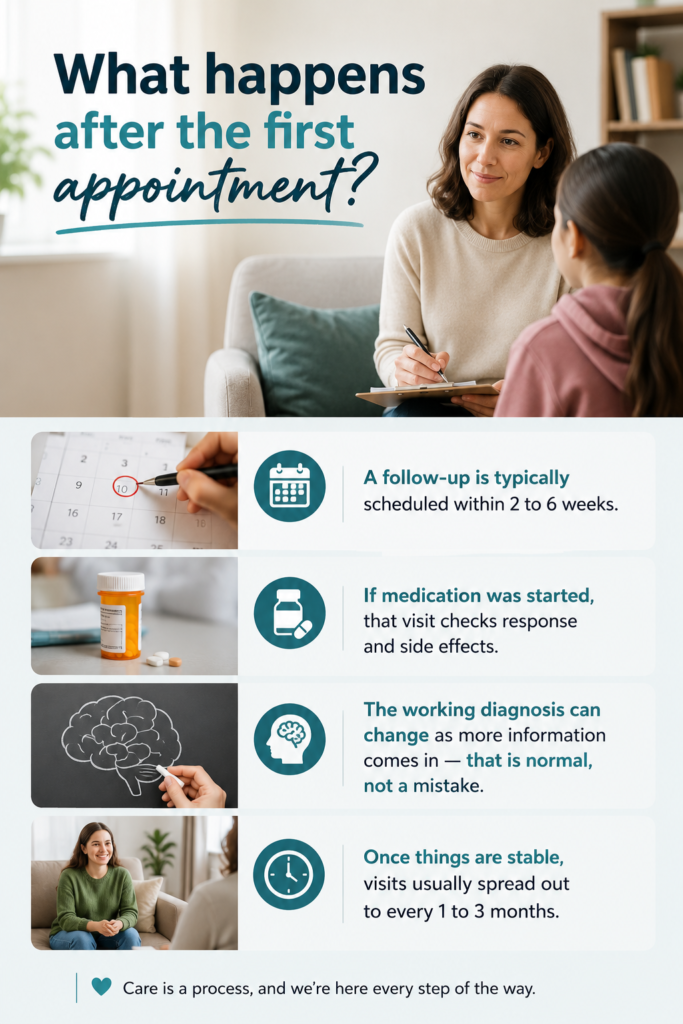
- A follow-up is typically scheduled within 2 to 6 weeks
- If medication was started, that visit checks response and side effects
- The working diagnosis can change as more information comes in — that is normal, not a mistake
- Once things are stable, visits usually spread out to every 1 to 3 months
Ongoing care is what psychiatry and medication management actually looks like: adjusting, tracking, and checking in, rather than one appointment that settles everything.
And if the fit is wrong, say so. A clinician you cannot be honest with is not a clinician who can help you, and asking to switch is a normal request in a well-run practice.
Frequently asked questions
Below are answers to the most common questions people have about what to expect at first psychiatric visit. This information should help ease any anxiety about your upcoming appointment.
How long is a first psychiatric evaluation?
Usually 45 to 60 minutes of clinical time, plus 10 to 15 minutes of paperwork beforehand. Plan for about 90 minutes at the office in total.
Is anything I say confidential?
Yes, with narrow legal exceptions your clinician will explain at the start — situations involving imminent danger to yourself or someone else, suspected abuse of a child or vulnerable adult, or a court order. Everything else stays between you and your care team.
Do I need a referral to see a psychiatrist in Texas?
Usually not. Most plans in Texas allow you to book behavioral health directly, though some HMO plans still require a referral from your primary care doctor. Call the member services number on your insurance card to confirm before you book.
What if I do not feel like the psychiatrist is the right fit?
Tell the office. Fit is a clinical variable, not a matter of politeness, and switching providers within a practice is a routine request. Starting over somewhere new every few months is what actually slows treatment down.
| If you need help right now If you are thinking about harming yourself or someone else, do not wait for an appointment. Call or text 988 to reach the Suicide and Crisis Lifeline, available 24 hours a day, or go to your nearest emergency department. |
This article is general educational information and is not a substitute for individualized assessment, diagnosis, or treatment by a licensed clinician; if you have urgent concerns about your safety, call 988 or seek emergency care.
Book your first appointment
Harmonyville provides psychiatric evaluation and ongoing care in Mansfield and McKinney, Texas. New patient evaluations are scheduled directly — no referral needed for most plans.
Request an appointment · Mansfield: (682) 341-3040 · McKinney: (682) 708-2797
Resources and References
For more information about psychiatric care and mental health treatment, consult these authoritative resources:
• The American Psychiatric Association – Learn more about psychiatric treatment and professional standards
• NAMI (National Alliance on Mental Illness) – Provides resources for mental health support and understanding psychiatric care
• National Institute of Mental Health – Offers evidence-based information about mental health conditions and treatment options