Anxiety treatment in Mansfield, TX usually starts with an evaluation, then a plan built from therapy, medication, or both. Cognitive behavioral therapy and exposure work are first-line for most anxiety disorders. Many people improve within a few months, though timelines vary by person. Treatment is available in person and by telehealth across Texas.
You have driven the same twenty minutes to work for three years, and lately your chest tightens somewhere around the third light. Nothing has changed about the drive. Something has changed about you, and the advice you have been given so far amounts to sleep more and worry less.
Here is what anxiety treatment actually looks like, who it helps, and how to tell when it is time.
What does anxiety treatment in Mansfield, TX involve?
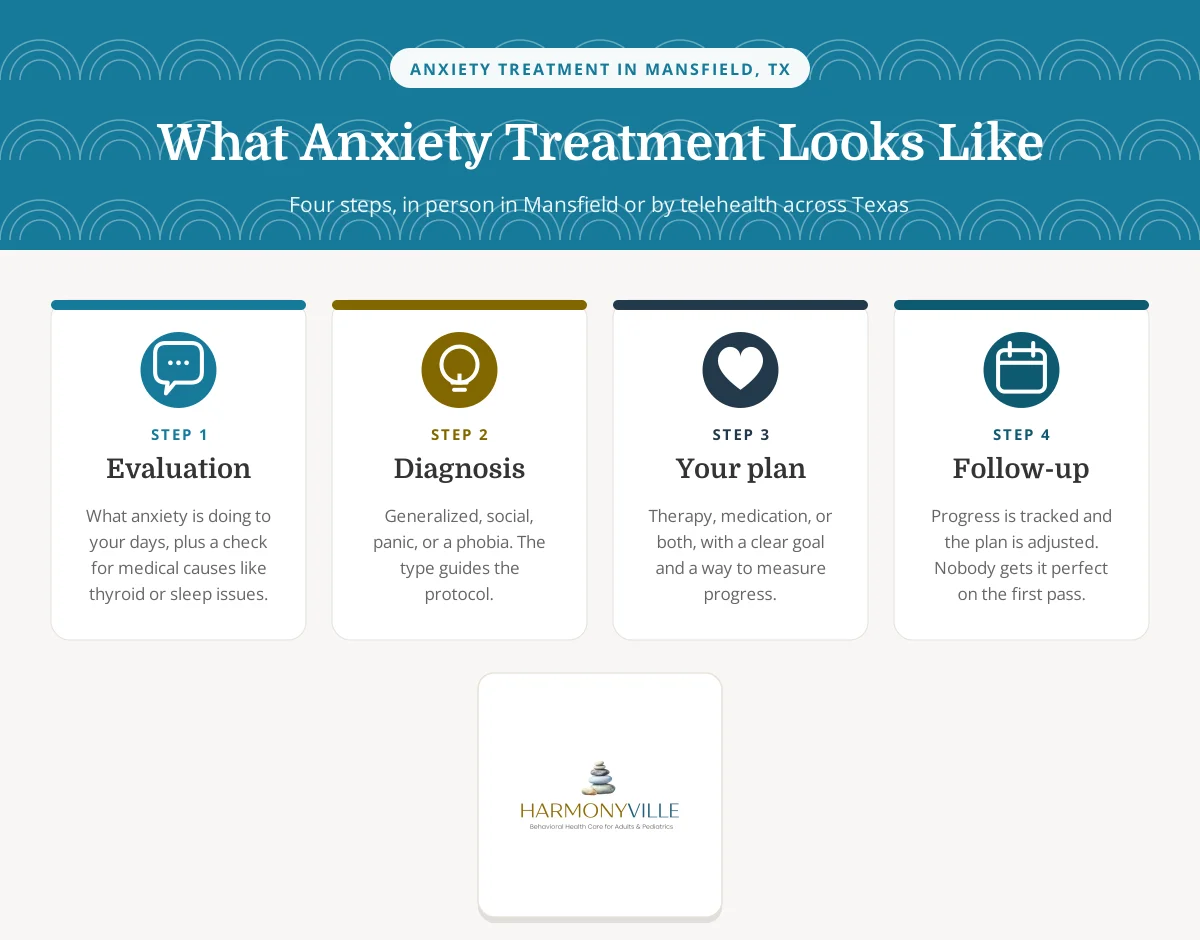
Anxiety treatment in Mansfield, TX follows four parts, in this order:
- An evaluation. A clinician asks what the anxiety does to your days, how long it has been going on, what you have already tried, and what else is going on medically. Thyroid problems, sleep apnea, and some medications produce symptoms that look exactly like anxiety, so this step matters.
- A diagnosis, if one fits. Generalized anxiety disorder, social anxiety disorder, panic disorder, and specific phobias are treated somewhat differently. The label is less about a box and more about which protocol to use.
- A plan. Usually therapy, medication, or both, with a stated goal and a way to tell whether it is working.
- Follow-up. Response gets tracked and the plan gets adjusted. Nobody gets it exactly right on the first pass.
Harmonyville treats adult anxiety at our Mansfield location and by secure video anywhere in Texas.

Related: Adult Anxiety Treatment →
How do I know if my anxiety needs treatment?
Anxiety is normal. Anxiety treatment becomes worth considering when it starts costing you things:
- Worry on most days for six months or more, and hard to switch off
- Sleep that will not come, or wakes you at 3am with the same loop running
- Avoiding meetings, phone calls, driving, social events, or appointments
- Physical symptoms with no medical explanation: racing heart, stomach trouble, headaches, muscle tension, that persistent feeling of being braced
- Alcohol, cannabis, or extra caffeine used to manage the feeling
- Work, school, or a relationship visibly suffering
One useful test: have other people started adjusting around it? When a partner stops suggesting plans because they know the answer, the anxiety has moved outside your head and into your life.
Anxiety disorders are among the most common mental health conditions in the United States, and they respond well to treatment (National Institute of Mental Health). The gap is not that treatment fails. It is that most people wait years before starting it.
What types of anxiety do adults get treated for?
Anxiety is a family of conditions, not a single one. The type matters because it shapes which anxiety treatment works best. These are the ones adults most often come to us about:
- Generalized anxiety disorder (GAD). Persistent worry that jumps from topic to topic: money, health, work, family. The content changes. The worrying does not.
- Social anxiety disorder. Intense fear of being judged or embarrassed, strong enough that people turn down promotions, skip events, or rehearse every phone call.
- Specific phobias. Fear tied to one trigger, such as driving on highways, flying, needles, or heights, that leads to planning your life around avoiding it.
- Health anxiety. Ongoing fear of having a serious illness, often with frequent symptom checking, searching online, or seeking reassurance that never quite lands.
- Anxiety alongside depression. The two travel together often. Treating only one of them tends to leave the other in the way.
Obsessive-compulsive disorder and post-traumatic stress are now classified separately from anxiety disorders, but they share many symptoms and are treated with related therapy approaches. If you are not sure which description fits, that is exactly what the evaluation is for. You do not need a label before you ask for help.
Is therapy or medication better for anxiety?
Both are effective forms of anxiety treatment. Which one you start with depends on severity, your history, and what you are willing to do.
Therapy teaches skills that keep working after treatment ends.
- Cognitive behavioral therapy (CBT) identifies the thought and behavior patterns driving the anxiety and tests them against reality
- Exposure and response prevention is the standard approach for panic, phobias, and obsessive-compulsive disorder
- Acceptance and commitment therapy (ACT) focuses on acting on what matters to you rather than arguing with every anxious thought
- Typically 45 to 60 minutes, weekly at first
Medication lowers the volume enough that the skills become learnable.
- Several antidepressant classes, including SSRIs and SNRIs, are standard long-term treatments for anxiety disorders
- Response usually builds over several weeks rather than days
- A prescriber reviews your medical history, other medications, and side effects before and during treatment
For moderate to severe anxiety, the combination tends to outperform either alone. Our clinicians frequently see people start medication first simply because therapy is hard to do when you cannot sit still long enough to get through a session.
Related: Individual Therapy →
Related: Psychiatry and Medication Management →
What happens at a first anxiety appointment?
The first visit for anxiety treatment in Mansfield, TX is an evaluation, not treatment. Expect about an hour:
- Intake paperwork and consent, often completed online beforehand
- History: what brought you in, when it started, what makes it better or worse, family history, current medications and supplements
- Screening questions about sleep, substance use, mood, and safety. These are routine and asked of everyone
- Goal setting: what you want to be different in three months, in concrete terms
- The plan: proposed approach, who you will see, how often, and what to expect next
Bring a list of your current medications and doses, any previous psychiatric records you have, and your insurance card. Write your questions down beforehand. People routinely leave a first appointment realizing they forgot the thing they most wanted to ask.
Before you leave, ask three things: what your clinician thinks is driving the anxiety, what the first month of anxiety treatment will look like, and how you should reach the office if symptoms get worse between visits. Having those answers in writing makes the plan easier to follow, and it gives you a clear starting point to measure progress against at your next appointment.
How long does anxiety treatment take?
The length of anxiety treatment depends on what is being treated:
- A specific phobia or a single situation: often 6 to 12 therapy sessions
- Generalized or social anxiety with a structured protocol: commonly 12 to 20 sessions
- Anxiety layered on trauma or long-standing patterns: longer, usually months
In anxiety treatment, medication timelines are different from therapy timelines, and both get reviewed as you go. You should be able to ask your clinician how they think treatment is progressing and what would tell them it is time to taper off. A vague answer to that question is worth pushing on.
What can I do for anxiety while I wait for my first appointment?
Self-help is not a replacement for anxiety treatment, but a few habits can take the edge off in the meantime and make therapy easier to start:
- Keep sleep regular. Same wake time every day, including weekends. Irregular sleep makes almost every anxiety symptom louder.
- Cut back on caffeine and alcohol. Caffeine can mimic a racing heart. Alcohol calms you for an evening and often leaves you more anxious the next day.
- Move your body. A brisk walk most days lowers baseline tension for many people. It does not need to be a workout plan.
- Try slow breathing. Breathing out for longer than you breathe in, for a few minutes at a time, can help settle a tense moment.
- Schedule your worry. Give worry a set 15 minutes a day. When it shows up at other times, write it down and save it for then.
- Keep doing the small things. Avoidance shrinks your world quickly. Keep the errands, calls, and drives you can manage, even if they feel uncomfortable.
Write down what you notice in the weeks before your visit: when anxiety spikes, what helps, what makes it worse. That record makes your first appointment far more productive. If symptoms are getting worse quickly, or you are having thoughts of harming yourself, do not wait for a scheduled visit. Call or text 988, or go to the nearest emergency department.
How do I choose an anxiety therapist or psychiatrist in Mansfield, TX?
Credentials tell you who is licensed. Fit and approach tell you who is likely to help. When you compare options for anxiety treatment in Mansfield, TX, it helps to know who does what:
- Licensed therapists (LPC, LCSW, LMFT) and psychologists provide talk therapy such as CBT, exposure work, and ACT.
- Psychiatrists and psychiatric nurse practitioners (PMHNP) evaluate, diagnose, and prescribe and manage medication. Many also provide brief therapy.
- A practice that has both under one roof makes it easier to coordinate therapy and medication without starting over with a new office.
A few questions worth asking before you commit:
- Do you use an anxiety-specific approach such as CBT or exposure therapy, and what would that look like for me?
- How will we measure whether this is working, and when will we review it?
- Are video sessions available if I cannot make it in person every week?
- If I need medication, who prescribes it, and how do the therapist and prescriber stay in touch?
Clear answers to those questions are a good sign. So is feeling that you can be honest with this person. Fit matters, and it is reasonable to switch clinicians if it is not working after a few sessions.
What if anxiety treatment has not worked before?
Getting anxiety treatment and getting the right anxiety treatment are different things. Before concluding that nothing works, it is worth checking a few things:
- Was the therapy an anxiety-specific protocol, or general talk therapy?
- Did medication get a fair trial at an adequate duration, or stop early because of early side effects?
- Was there an undiagnosed condition underneath, such as depression, ADHD, or a sleep disorder?
- Did anything medical get ruled out?
If depression has traveled alongside the anxiety and several medications have not helped, a psychiatric evaluation can review the wider set of options available at Harmonyville, including TMS and ketamine-assisted treatment. Those are appropriate for some people and not others, and eligibility is decided in a consultation with a clinician rather than from an article.
How can I support a partner or family member with anxiety?
Living with someone who is anxious is hard, and the instinct to help can quietly make anxiety stronger. Some ways to help that tend to work:
- Offer support without taking over. Driving them everywhere, making every phone call, or canceling plans on their behalf brings short-term relief but teaches the brain that the feared thing really is dangerous.
- Limit repeated reassurance. Answering the same worried question again and again usually helps for minutes, not days. Kindly name the pattern instead.
- Help with the logistics of getting care. Offer to look up providers, sit with them while they call, or drive them to the first appointment.
- Notice effort, not just results. Going to the grocery store at a busy hour may be a big step, even if it does not look like one.
- Look after yourself too. Supporting someone through anxiety is easier when your own sleep, time, and support are protected.
If you are the one seeking anxiety treatment, it can help to bring a partner to one session so they understand the plan and how to support it.
What to expect from anxiety treatment at HarmonyVille in Mansfield, TX
Our Mansfield office is set up for adults who want anxiety treatment in Mansfield, TX without bouncing between separate offices for therapy and medication. Here is how it usually works:
- One evaluation, one plan. Your clinician reviews your history, symptoms, and goals, then recommends therapy, medication management, or both.
- Therapy and psychiatry in one practice. If you see both a therapist and a prescriber, they work from the same plan, so you are not repeating your story.
- In person or by video. Visits can happen at the Mansfield office or by secure telehealth anywhere in Texas, and many people mix the two.
- Regular check-ins on progress. Your adult anxiety treatment plan gets reviewed as you go, and changed if something is not helping.
The Mansfield location is a short drive for adults in Arlington, Kennedale, Grand Prairie, Midlothian, and Burleson. If you are looking for an anxiety therapist in Mansfield, TX, or a psychiatrist to review medication options, the first step is the same: request an evaluation and tell us what the anxiety is getting in the way of.
Frequently asked questions
Can anxiety be treated without medication?
Yes. CBT and exposure-based therapy are first-line treatments on their own, and many people with mild to moderate anxiety do well with therapy alone. Medication becomes more useful when symptoms are severe enough to interfere with doing the therapy itself, or when depression is present too.
Can my primary care doctor treat my anxiety?
Often, yes, especially for mild to moderate anxiety. Many primary care doctors can screen for anxiety, start a medication, and refer you to therapy. A psychiatric evaluation becomes more useful when symptoms are severe, when first treatments have not helped, or when other conditions such as depression or ADHD are part of the picture.
Does insurance cover anxiety treatment in Texas?
Most plans cover outpatient behavioral health, though copays, deductibles, and network status vary. Verify with your plan’s member services line, or ask our office to check your specific coverage before your first appointment.
Is online therapy for anxiety as effective as in person?
For most anxiety concerns, video sessions work comparably to in-office visits, and they remove the commute that can itself be a barrier. In-person visits are often better for first evaluations, for trauma protocols, and for anyone without private space at home. A mixed schedule is common.
Do I need a referral to be seen?
Most plans do not require one for outpatient behavioral health, but some HMO plans do. Check your card or call the number on the back before you book.
This article is general educational information and is not a substitute for individualized assessment, diagnosis, or treatment by a licensed clinician. If you are thinking about harming yourself, call or text 988 to reach the Suicide and Crisis Lifeline, available 24/7, or go to your nearest emergency department.
Start anxiety treatment in Mansfield
You do not need to have it figured out before you start anxiety treatment in Mansfield, TX. Request an appointment at harmonyvillepsych.com/request-an-appointment or call our Mansfield office at Call (682) 341-3040. Tell us what the anxiety is interfering with most, and we will put you with the right clinician.