Almost nothing. A psychiatric evaluation works best when you are fully honest, including about symptoms, substance use, and thoughts of self-harm. What you share is confidential under Texas and federal law, with narrow exceptions for imminent danger, abuse, and court orders. Holding back is what actually hurts your care.
If you are wondering what not to say during a psychiatric evaluation, you have probably already decided to go. That takes courage. What you may be looking for now is reassurance that it is safe to tell the truth once you are in the room. This guide explains what actually gets in the way of a good evaluation, what stays private, and what happens to the information you share.
What not to say during a psychiatric evaluation
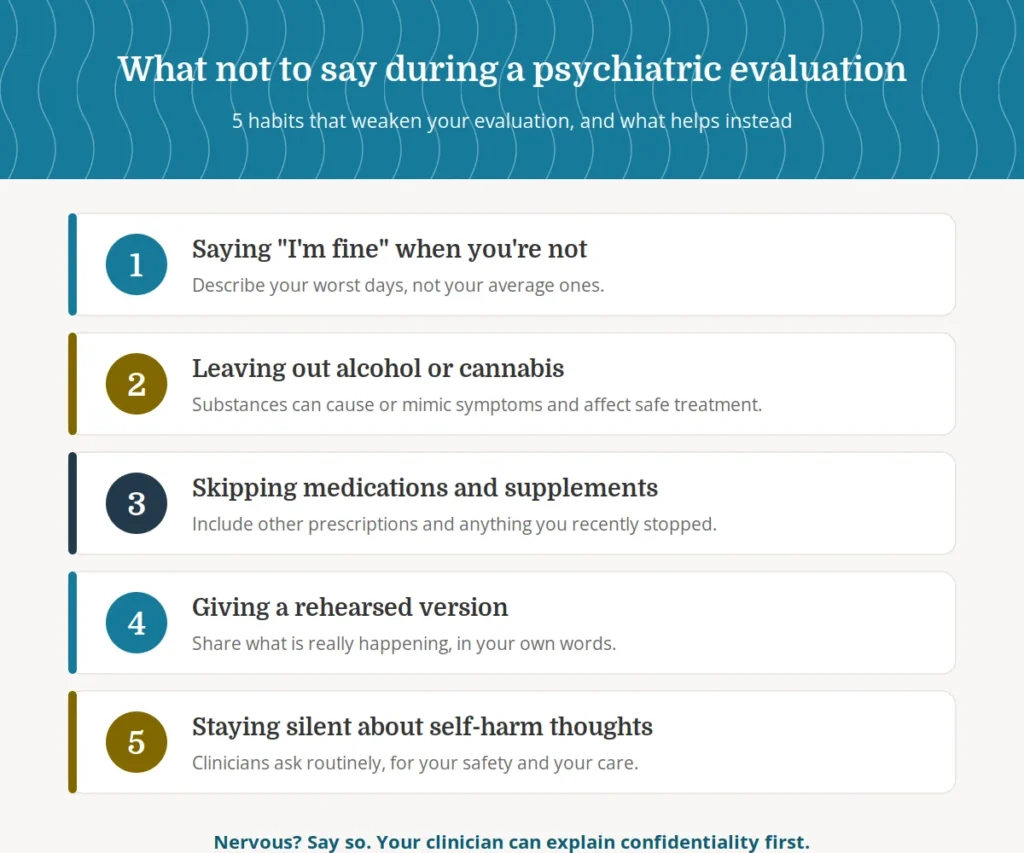
There is very little you should avoid saying. The things that weaken an evaluation are rarely confessions. They are gaps. These five habits cause the most trouble:
- Saying “I’m fine” when you are not. Minimizing symptoms is the most common reason people leave with a plan that does not fit what they are living with. Describe your worst days, not your average ones.
- Leaving out alcohol, cannabis, or other substances. Substance use can cause or mimic symptoms like anxiety, low mood, and poor sleep, and it affects which treatments are safe for you.
- Skipping over medications and supplements. Include prescriptions from other providers, over-the-counter products, supplements, and anything you stopped taking recently, along with why you stopped.
- Giving a rehearsed version of events. Telling the clinician what you think they want to hear, or repeating what a family member told you to say, makes it harder to understand what is really happening.
- Staying silent about thoughts of self-harm. This is the one people fear most. Clinicians ask about it routinely because it matters for your safety and your treatment, not because they are looking for a reason to take action against you.
What to say instead: if you are nervous, say so. “I’m worried about how this information will be used” is a completely reasonable thing to say at the start of an appointment. Your clinician can walk you through confidentiality before you go any further, so you can decide what to share with the facts in front of you.
Why do people hold things back in a psychiatric evaluation?
Almost everyone edits themselves a little the first time. The reasons are understandable: fear of being labeled, worry that a diagnosis will follow you to a job or a custody case, concern that an employer will find out, fear of being hospitalized, or simply embarrassment. Some people had a bad experience with a past provider and walk in expecting to be judged.
Most of these fears come from not knowing what happens to your information after you say it. The sections below answer those questions directly, so you can walk in knowing where the real limits are. If you would rather know what the appointment itself looks like, read What Happens During a Psychiatric Diagnostic Interview, or our guide to preparing for a psychiatric medication evaluation.

Is a psychiatric evaluation confidential in Texas?
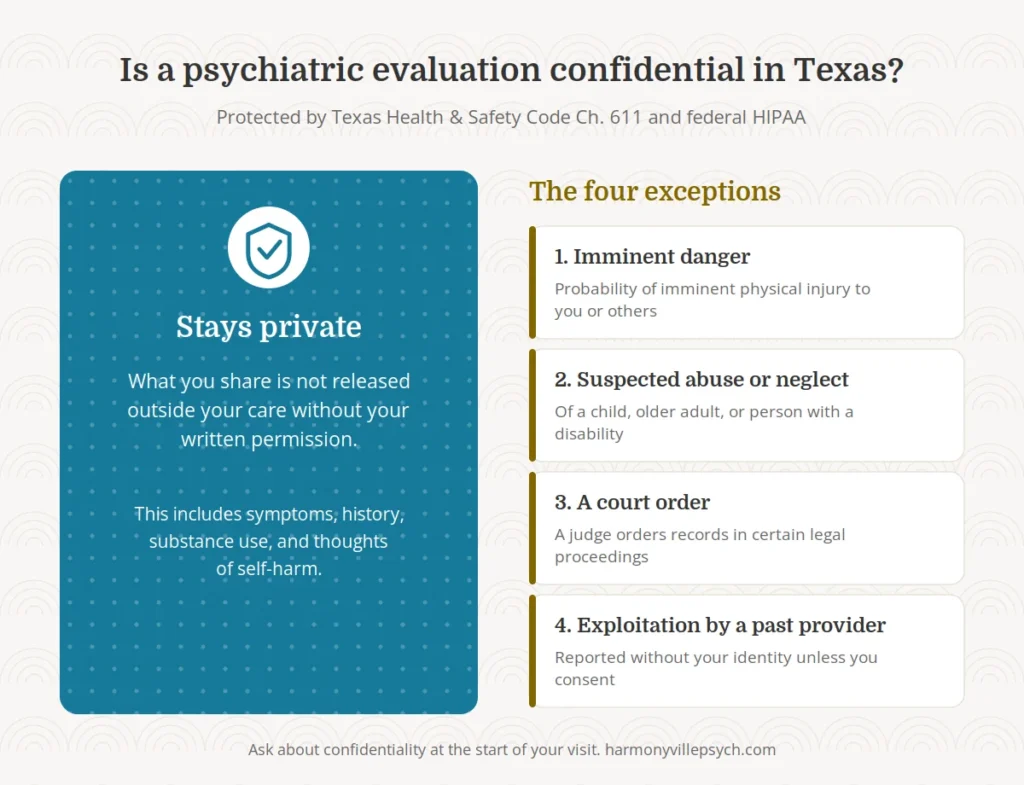
Yes, with a small number of exceptions. Mental health information in Texas is protected by state law (Texas Health and Safety Code, Chapter 611) and by federal privacy law under HIPAA. In practice, that means what you discuss is not shared with anyone outside your care without your written permission, except in these situations:
- Imminent danger. Your clinician believes there is a probability of imminent physical injury to you or to someone else.
- Suspected abuse or neglect. Texas law requires clinicians to report suspected abuse or neglect of a child, an older adult, or a person with a disability.
- A court order. A judge can order records released in certain legal proceedings.
- Exploitation by a previous provider. If you disclose sexual exploitation by a former mental health provider, Texas requires a report, and your identity is not shared without your consent.
Outside of those exceptions, your information stays within your care. If you want to understand how these rules apply to your specific situation, ask at the very beginning of your visit. You can learn more about how evaluations fit into ongoing care on our Psychiatry & Medication Management page.
Could what I say lead to hospitalization?
Rarely, and not because you were honest about struggling. Having thoughts of suicide, even frequent ones, is not on its own a reason to be hospitalized. What a clinician looks at is immediate risk: whether you have a plan, whether you intend to act on it, whether you have access to the means, and whether you feel able to keep yourself safe.
Most of the time, the response to honest disclosure is collaborative. That can look like a written safety plan, more frequent follow-up, adjustments to treatment, or bringing in support people you choose. When a higher level of care does seem necessary, voluntary options are discussed first whenever possible.
In Texas, involuntary emergency detention is a legal process reserved for situations where a person with a mental illness poses a substantial risk of serious harm to themselves or others and that risk is imminent. No honest clinician can promise it will never happen. What is true is that being open gives you far more say in your own care than staying silent does.
Who sees what I say after the evaluation?
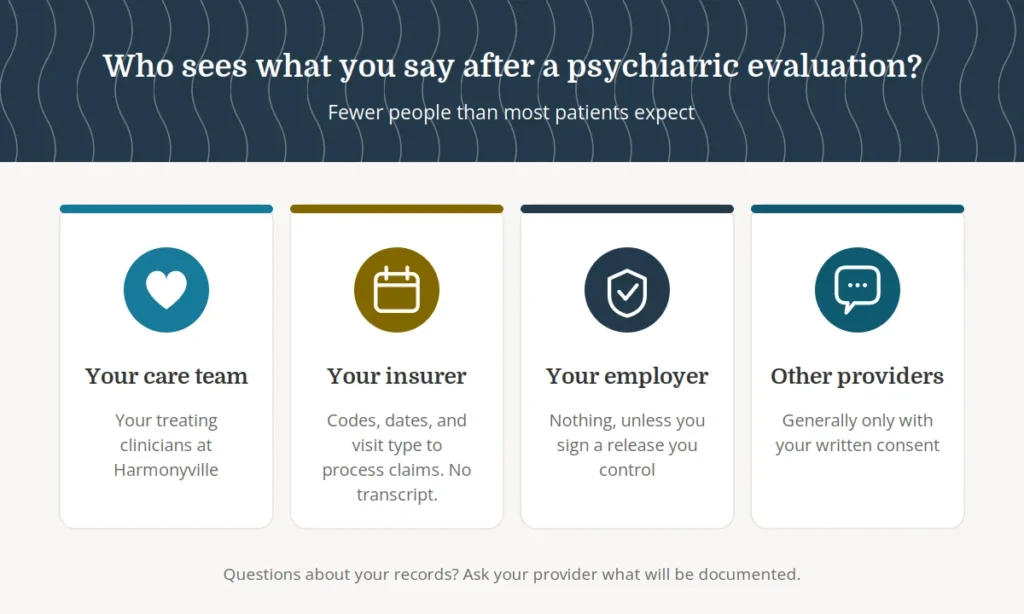
Fewer people than most patients expect. Worry about who will read your answers is one of the main reasons people search for what not to say during a psychiatric evaluation. Here is how it typically breaks down:
- Your care team. The clinicians involved in your treatment at Harmonyville. You can Meet Our Providers before your first visit.
- Your insurance company, if you use insurance. Insurers receive what they need to process a claim, such as diagnosis codes, dates of service, and the type of visit. They do not receive a transcript of your conversation.
- Your employer. Your employer does not receive your evaluation, even if your insurance is through work. Information is only shared if you sign a release, for example for leave paperwork, and you control what that release covers.
- Other providers. Your primary care doctor or other specialists generally receive information only with your written consent.
If any of this is a specific concern for you, raise it. Your provider can explain exactly what will be documented and who will see it.
Frequently asked questions
Can I refuse to answer a question in a psychiatric evaluation?
Yes. You can say, “I’m not ready to talk about that yet.” Your clinician may explain why the question matters, but the choice is yours. Declining to answer is always better than giving an answer that is not true, because it keeps the door open for later.
Should I mention how much I drink or smoke?
Yes, and be as specific as you can. The question is not about judgment. Alcohol, nicotine, and cannabis all affect sleep, mood, and anxiety, and they can change how medications work. Accurate amounts help your provider recommend treatment that is safe for you.
What if I do not want to take medication?
Say so. An evaluation is not a commitment to medication. Your provider can talk through all of your options, including therapy, and the two of you decide on a plan together. Sharing your preferences up front leads to a plan you are more likely to stick with.
What if I was not fully honest in a past evaluation?
That is more common than you might think, and it is easy to correct. Simply tell your current clinician, “Last time I said this, but the truth is that.” There is no penalty for updating your history. It only helps your provider understand you better.
If you need help right now
If you or someone else is in immediate danger, call 911. If you are having thoughts of suicide or are in a mental health crisis, call or text 988 to reach the 988 Suicide & Crisis Lifeline, available 24 hours a day, 7 days a week. Please do not wait for a scheduled appointment.
Book a psychiatric evaluation in Mansfield or McKinney
Knowing what not to say during a psychiatric evaluation really comes down to one thing: do not hide what you are going through. You do not need the right words or a perfect memory of your history. Our team in Mansfield and McKinney, TX will take it from there, at a pace that feels manageable for you.
Call our Mansfield office at 682-341-3040, our McKinney office at 682-708-2797, or request an appointment online.