The difference between a psychiatrist and a therapist comes down to training and role: a psychiatrist is a medical doctor who diagnoses mental health conditions and prescribes medication, while a therapist is a licensed clinician who provides talk therapy but does not prescribe. Many people see both — the psychiatrist manages medication, the therapist does the weekly work. Which you start with depends on your symptoms.
Your insurance directory lists dozens of names and half of them have letters after them you’ve never seen before. LPC. PMHNP. PsyD. LCSW. Somewhere in that list is the person who can actually help, and nothing on the page tells you which one.
Here’s what each role does, what the credentials mean, and how to pick a starting point.
What is the difference between a psychiatrist and a therapist?
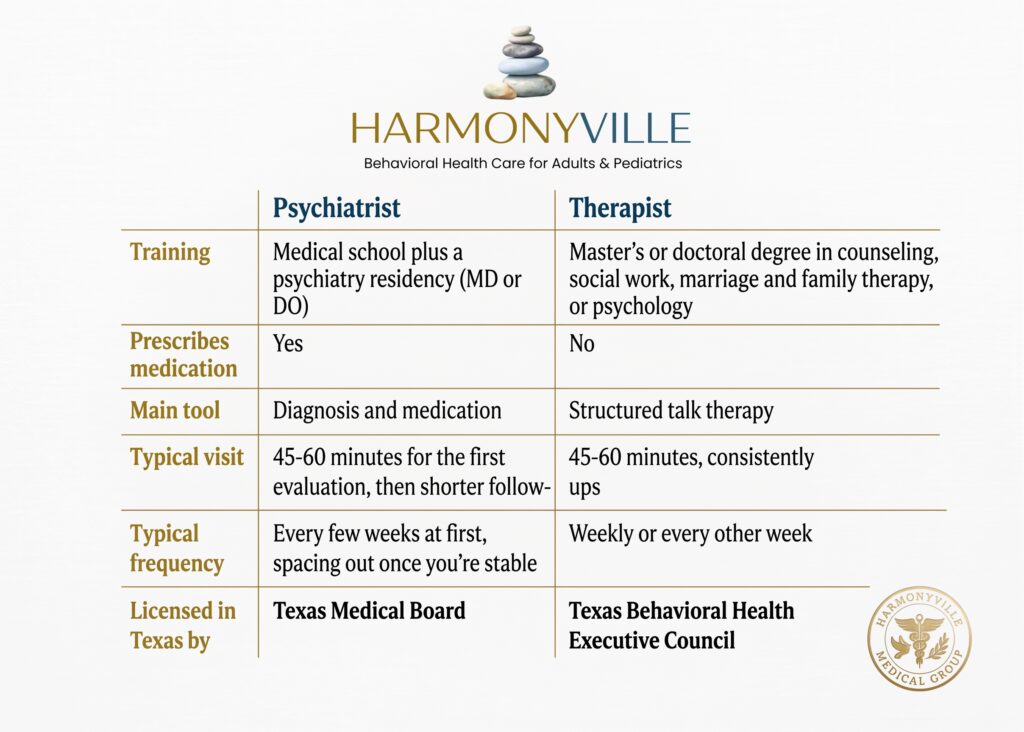
The shortest version: a psychiatrist is asking what is happening in your brain and body, and does medication have a role. A therapist is asking what patterns are keeping this going, and what skills change them. Those are different questions, and for a lot of people the answer is that both need asking.
What does a psychiatrist actually do?

- Evaluates and diagnoses — a full history covering symptoms, timeline, medical conditions, family history, substances, and safety
- Prescribes and adjusts medication, then monitors response and side effects over time
- Rules out medical causes. Thyroid disease, sleep apnea, anemia, and medication interactions can all look like depression or anxiety
- Coordinates care with your therapist and primary care doctor
- Discusses further options when medication and therapy haven’t produced enough change
That last point is where people most often get stuck. If two or three medications haven’t worked, that is a recognized clinical situation with a name — treatment-resistant depression — and it opens a different conversation rather than closing one. Whether any additional treatment is appropriate for you depends on your diagnosis, history, and current medications, which is what a consultation is for.
Internal link: Psychiatry & Medication Management →
What does a therapist actually do?

- Provides structured talk therapy using an evidence-based approach matched to the problem — CBT for anxiety and depression, EMDR for trauma, ACT, DBT skills
- Builds skills you use between sessions, not just insight during them
- Works on patterns — relationships, avoidance, self-criticism, grief, life transitions
- Tracks progress against goals you set together in the first few sessions
Therapists do not prescribe. What they do have is time: a weekly hour is a fundamentally different kind of contact than a medication check-in every six weeks, and it’s where most of the durable change happens.
Internal link: Individual Therapy →
What do LPC, LCSW, PMHNP, and PsyD mean?
The credential tells you the training and, critically, whether the person can prescribe:
- MD / DO — physician. A psychiatrist is a physician who specialized in mental health. Prescribes
- PMHNP — psychiatric mental health nurse practitioner. Evaluates, diagnoses, and prescribes; in Texas, under a prescriptive authority agreement with a physician
- PA — physician assistant, practicing under physician delegation. Prescribes
- PhD / PsyD — psychologist. Doctoral-level; does therapy and, uniquely, formal psychological and diagnostic testing. Does not prescribe in Texas
- LPC — licensed professional counselor. Master’s-level talk therapy
- LCSW — licensed clinical social worker. Master’s-level talk therapy, with training in systems and resources
- LMFT — licensed marriage and family therapist. Master’s-level, relational focus
“Therapist” and “counselor” are umbrella words, not licenses. Anyone providing therapy in Texas should hold one of the licenses above, and you can verify any of them yourself through the Texas Behavioral Health Executive Council.
Should I see a psychiatrist or a therapist first?

Start with a psychiatrist when:
- You want to know whether medication is worth considering, or you’re already on something that isn’t working
- Symptoms are severe — you can’t work, sleep, or eat, or you’re having thoughts of harming yourself
- You need diagnostic clarity, especially where ADHD, bipolar disorder, or a medical cause may be in play
- Previous medication trials have failed
Start with a therapist when:
- Symptoms are mild to moderate and you’re still functioning
- The problem is clearly situational — a breakup, a job loss, grief, a move
- You’d rather try skills and talk therapy before medication
- You’ve been on medication that’s working fine and want to add the other half
If you genuinely can’t tell, book the psychiatric evaluation. An evaluation can recommend therapy alone, but a therapy intake can’t prescribe or rule out a medical cause. Parents frequently ask us this about a teenager, and the same logic applies — the evaluation is the wider net.
Internal link: Our Providers →
Can I see a psychiatrist and a therapist at the same time?
Yes, and it’s the most common arrangement we see. Combined medication and therapy is standard practice for moderate to severe depression and anxiety (National Institute of Mental Health).
Practically, that looks like a weekly or biweekly therapy hour plus a medication visit every one to three months. The two clinicians should be talking to each other — when both work inside one practice, that coordination happens without you having to relay messages between two offices.
Frequently asked questions

Can a therapist prescribe medication?
No. In Texas, prescribing authority sits with physicians, psychiatric nurse practitioners, and physician assistants. Psychologists in Texas do not have prescriptive authority, even at the doctoral level — that differs from a small number of other states, which is a common source of confusion.
Do I need a referral to see a psychiatrist in Texas?
Usually not. Most plans allow you to book behavioral health directly, though some HMO plans still require a referral from your primary care doctor. Check the back of your insurance card or call member services before you book.
What’s the difference between a psychiatrist and a psychologist?
Training and tools. A psychiatrist is a medical doctor who can prescribe. A psychologist holds a doctorate in psychology, provides therapy, and administers formal psychological testing — the standardized assessments used to clarify ADHD, learning disorders, and complex diagnostic questions — but does not prescribe in Texas.
What if the provider I see isn’t the right fit?
Say so. Fit is a clinical variable, not a matter of politeness, and it’s worth raising after two or three sessions rather than quietly stopping. A well-run practice will help you switch rather than take it personally.
If you’re in crisis right now, don’t wait for an appointment. Call or text 988 to reach the Suicide and Crisis Lifeline, available 24/7, or go to your nearest emergency department.
This article is general educational information and is not a substitute for individualized assessment, diagnosis, or treatment by a licensed clinician.
Not sure which one you need? Start with an evaluation.
Understanding the difference between a psychiatrist and a therapist is the first step to getting the right care. Harmonyville has psychiatrists and therapists under one roof in Mansfield and McKinney, so you don’t have to diagnose your own care before you can book it. Tell us what’s going on and we’ll route you to the right clinician.
Request an appointment at harmonyvillepsych.com/request-an-appointment, or call:
- Mansfield — (682) 341-3040
- McKinney — (682) 708-2797