What if the internal friction you’ve felt for decades isn’t a personal failing, but rather a neurological blueprint that simply hasn’t been given a name? For many, the realization that they might be on the spectrum comes after years of carefully masking their traits or feeling fundamentally different from those around them. If you are seeking clarity, understanding the adult autism diagnosis Texas process requires a specific clinical approach that balances medical precision with deep personal empathy. You might worry that your professional success or social adaptations will cause a clinician to overlook your struggles, yet your lived experience deserves a thorough and specialized evaluation that looks beyond surface-level functioning.
We understand that the process can feel overwhelming, especially when faced with university waitlists that often stretch from 6 to 18 months. This guide serves as your professional roadmap, offering a clear path through the clinical and financial landscape, including how Texas insurance law changes effective January 2026 have expanded access for adults. You will learn the vital differences between a simple screening and a formal diagnostic evaluation; additionally, we provide a structured plan for managing co-occurring challenges like ADHD or anxiety. By the end of this article, you’ll have the tools to secure a diagnosis that provides both professional validation and a foundation for your long-term well-being.
Key Takeaways
Here is what to know about getting an adult autism diagnosis Texas providers can deliver.
- Discover the essential clinical milestones, from the initial screening to the comprehensive developmental evaluation, that ensure your diagnostic results are both valid and supportive.
- Learn the specific steps for the adult autism diagnosis Texas process by understanding the shift from pediatric standards to adult-focused diagnostic frameworks.
- Navigate the complexities of insurance coverage and medical necessity, including how recent Texas legislative changes have expanded access to professional testing for adults.
- Move beyond the clinical label with a proactive plan to address co-occurring conditions like ADHD or anxiety while processing the emotional impact of your new clarity.
- Explore how a patient-first clinical partnership in Mansfield or McKinney can provide the structured support and specialized care you need for long-term resilience.
Adult Autism Diagnosis Texas: Understanding the Path
The journey toward self-discovery often begins with a quiet realization that the social scripts everyone else seems to follow don’t quite match your own. Historically, clinical frameworks viewed autism primarily through a pediatric lens, focusing on children who presented with high support needs. This left a generation of adults, particularly those in Texas, to navigate life without a name for their unique neurological profile. Today, the shift toward adult diagnostic frameworks acknowledges that autism is a lifelong condition. Understanding the adult autism diagnosis Texas process involves moving past these outdated childhood models to embrace a comprehensive clinical evaluation that respects your maturity and life experience.
Many adults have spent decades “masking,” which is the exhausting process of mimicking social behaviors to blend in. While this might lead to professional success, it often results in profound internal burnout. While online quizzes or self-screenings can provide a helpful starting point, they lack the clinical depth required for a formal identification. A professional evaluation utilizes the Diagnostic and Statistical Manual of Mental Disorders (DSM-5) to provide a standardized, evidence-based conclusion. In Texas, this formal diagnosis acts as a medical and legal key; it opens doors to specific protections and targeted therapeutic support that self-identification cannot provide.
Why Seek a Formal Diagnosis Now?
Securing a formal diagnosis is about more than just a label. It’s about accessing your legal rights and improving your daily quality of life. Under the Americans with Disabilities Act (ADA), a documented diagnosis allows you to request reasonable workplace accommodations, such as modified lighting or flexible sensory breaks. Beyond the office, it offers a profound sense of validation for lifelong sensory patterns that may have previously caused shame. When you understand your neurology, treatments for co-occurring anxiety or depression become significantly more effective because they’re tailored to an autistic brain rather than a neurotypical one.
The Role of Neurodiversity-Affirming Care
Modern psychiatry is evolving away from “fixing” deficits and toward a support-based model. In Texas, providers are increasingly trained to recognize how autism presents in adults, especially in women and non-binary individuals who were historically overlooked. These presentations often involve internalizing struggles rather than externalizing them. Neurodiversity-affirming care validates these experiences, viewing your traits as differences in processing rather than brokenness. If you’re researching the adult autism diagnosis Texas process, choosing a provider who values this affirming perspective is the first step toward a restorative experience. This approach ensures that your evaluation feels like a collaborative partnership rather than a cold clinical interrogation.
The 4-Step Process: From Initial Screening to Clinical Evaluation
Every adult autism diagnosis Texas clinicians provide follows a structured sequence, and knowing each step ahead of time reduces uncertainty.
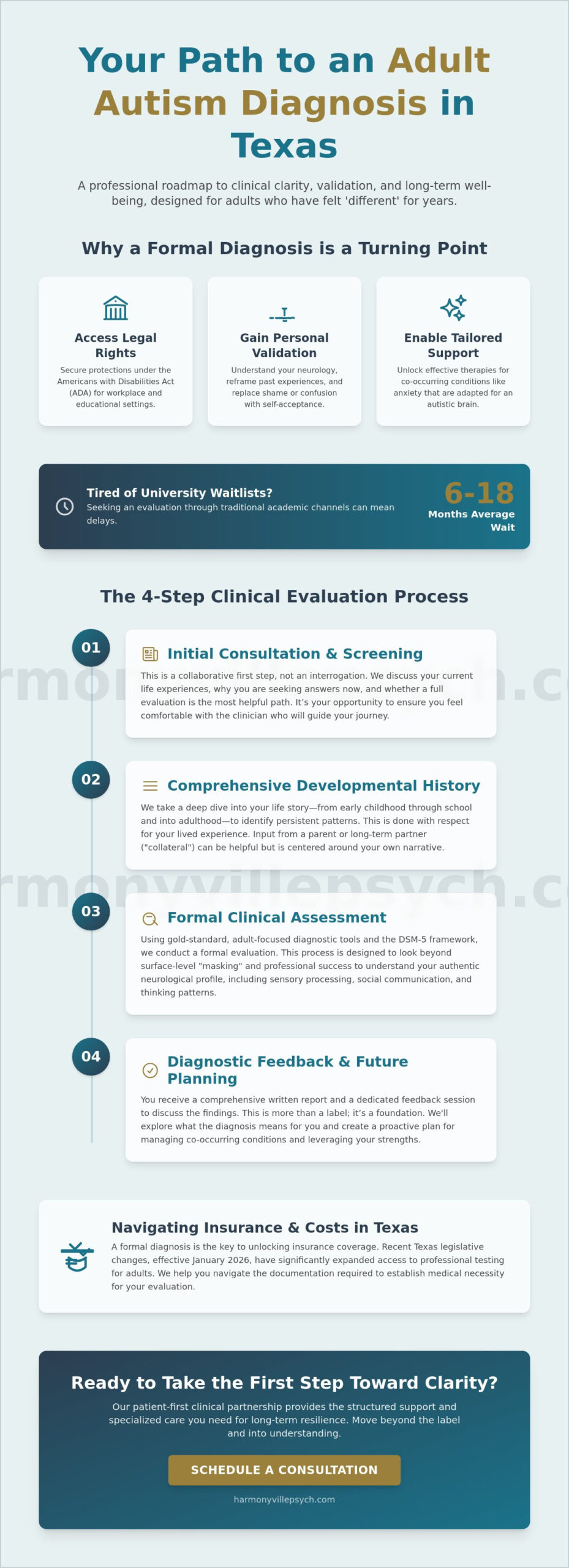
Finding clarity about your neurodivergence isn’t a race; it’s a methodical uncovering of your authentic self. If you’re researching the adult autism diagnosis Texas process, you’ll find that the process is designed to be thorough yet supportive. It begins with an initial psychiatric consultation where we discuss your current life experiences and why you’re seeking answers now. This first step acts as a clinical screening to ensure that a full evaluation is the most helpful path forward for your specific needs. It’s a time for you to ask questions and feel comfortable with the clinician who will be your partner in this journey.
Once we move into the formal assessment, the second step involves a deep dive into your developmental history. We look at your early childhood, school years, and early adulthood to identify patterns that have persisted over time. While we often speak with “collateral” sources, such as a parent or long-term partner, your own lived experience remains the primary focus. This leads into the third step: standardized diagnostic testing. This phase utilizes evidence-based tools to observe how you process information and interact with the world around you. Finally, the process concludes with a dedicated feedback session. During this meeting, we review the findings in detail and provide you with a comprehensive diagnostic report that acts as a roadmap for your future care.
Preparing for Your Evaluation
Preparation can significantly lower the anxiety often associated with clinical testing. You don’t need to have every detail of your childhood memorized, but gathering old school records or IEP documents can provide valuable context for the clinician. Many adults find it helpful to keep a “symptom journal” for a week or two before their appointment, noting specific instances of sensory overload or social friction. If you’re navigating the adult autism diagnosis Texas process without family involvement, don’t worry. While interviews with family members offer a historical perspective, they aren’t always mandatory for a valid adult diagnosis.
Standardized Testing for Adults
The tools used in an adult autism evaluation are more nuanced than those used for children. A clinical professional will typically use a thorough clinical interview and a formal autism assessment, such as the ADOS-2, which is adapted to respect your adult maturity. These tests aren’t “pass or fail” exams; they are opportunities to observe your natural cognitive and behavioral style. According to the DSM-5-TR, Autism Spectrum Disorder in adults is characterized by persistent challenges in social communication and the presence of restricted, repetitive patterns of behavior or interests that have existed since early development. By combining behavioral observations with cognitive testing, we create a full profile that explains not just “what” you experience, but “why” you experience it.
Navigating Costs, Insurance, and Documentation in the Lone Star State
Cost and coverage are often the biggest questions people have about an adult autism diagnosis Texas providers offer.
Understanding the financial landscape of adult neurodevelopmental care is just as crucial as the clinical evaluation itself. In Texas, the path to coverage has historically been complex, but recent legislative progress has created a more accessible environment. As of January 1, 2026, Texas Senate Bill 563 removed the requirement that an individual must be diagnosed before age 10 to receive insurance coverage. This change is a significant victory for those seeking an adult autism diagnosis Texas, as it ensures that state-regulated health plans must recognize the validity of adult-onset identification. When you begin this process, it’s vital to distinguish between “medical necessity” and “educational need.” While a university might require testing for classroom accommodations, insurance providers focus on medical necessity, which justifies the clinical care, therapy, or psychiatric support you may require after your assessment.
Many patients find that their preferred specialists in the Dallas-Fort Worth area or Austin operate on a private-pay basis to maintain a higher standard of individualized care. If your provider is out-of-network, you can request a “superbill,” which is a detailed document you submit to your insurance company for potential reimbursement. When researching what to expect when getting an adult ASD diagnosis, remember that the administrative side requires as much preparation as the clinical side. A Texas-valid diagnostic report must be comprehensive; it should include specific ICD-10 codes and a clear clinical summary to be accepted for FMLA or ADA purposes. This documentation acts as your formal verification, ensuring your rights are protected under both state and federal law.
Insurance vs. Private Pay in Texas
Major Texas insurers like Blue Cross Blue Shield of Texas, Aetna, and Cigna have specific criteria for authorizing adult autism evaluations. Before booking your first appointment, call your member services department and ask if they cover “neuropsychological testing for diagnostic purposes” under your specific plan. While state-regulated plans are now more inclusive, some self-funded ERISA plans common in large corporations are governed by federal law and may have different rules. If you choose a private-pay model, you’re often trading the complexity of insurance claims for shorter wait times and a more intimate, patient-first diagnostic experience. This choice allows your clinician to focus entirely on your unique profile without the constraints of restrictive insurance coding.
Documentation for Workplace Accommodations
Once you’ve secured your diagnosis, your final report becomes a powerful tool for professional stability. To grant sensory or schedule adjustments, Texas employers typically require a “functional impact” statement. This section of your report explains how your autistic traits specifically interact with your job duties, such as a need for noise-canceling headphones in an open-office plan or written rather than verbal instructions. It’s important to know that you’re entitled to privacy; your employer needs to know your functional needs and the fact that you have a documented disability, but they don’t necessarily need to see your full developmental history. Having a clear, professional report ensures that the adult autism diagnosis Texas process translates into real-world support that preserves your career and your mental health.
Beyond the Label: Integrating Your Diagnosis into a Mental Health Plan
An adult autism diagnosis Texas residents receive is most useful when it connects directly to ongoing care.
Receiving your results is a milestone, but it often brings a complex emotional wave known as the “post-diagnosis fog.” You might feel a profound sense of relief that your lifelong experiences finally have a name, yet this is frequently accompanied by a period of mourning for the support you didn’t receive as a child. Moving through this phase requires more than just a certificate of diagnosis; it requires a proactive mental health plan that respects your unique neurology. Understanding the adult autism diagnosis Texas process is only the first chapter. The subsequent steps involve learning how to support your brain’s specific needs so you can stop simply surviving and start truly thriving in your personal and professional life.
A comprehensive plan often addresses the co-occurring conditions that frequently accompany an autistic profile. It’s common for adults to discover they also have ADHD, a combination often referred to as “AuDHD,” or to realize that their chronic anxiety is actually a result of sensory overstimulation. While autism itself isn’t something to be “treated” with medicine, psychiatry and medication management are vital for managing the secondary symptoms that drain your energy. For example, treating executive dysfunction or the physiological symptoms of anxiety can provide the mental clarity you need to implement helpful daily routines. If standard treatments have failed you in the past, alternative options like Transcranial Magnetic Stimulation (TMS) or Ketamine Therapy may offer a path forward by encouraging neuroplasticity in brains that have been stuck in a cycle of “autistic burnout.”
Comorbidity and Differential Diagnosis
Autism in adults is frequently misdiagnosed as Bipolar Disorder or Borderline Personality Disorder (BPD) due to the intensity of sensory meltdowns or social withdrawal. These misidentifications happen because many clinicians aren’t trained to see the underlying sensory or communication differences that drive these behaviors. The overlap between Autism and ADHD is particularly high, with many patients finding that once their autism is identified, their ADHD symptoms become more apparent. A psychiatrist is uniquely qualified to untangle these diagnoses because they possess the specialized medical training to differentiate between neurodevelopmental traits and the symptoms of complex mood or personality disorders. If you are ready to build a personalized support plan, our team at HarmonyVille offers specialized psychiatry and medication management to help you thrive after your diagnosis.
Therapeutic Options for Autistic Adults
Individual psychotherapy for autistic adults should look different than traditional talk therapy. It must be neurodivergent-affirming, focusing on practical strategies for sensory regulation and self-advocacy rather than trying to “fix” your social style. For those struggling with the deep, persistent depression associated with years of masking, TMS therapy can be a game-changer; it’s a non-invasive way to stimulate brain regions responsible for mood regulation without the systemic side effects of some medications. Additionally, group therapy provides a safe harbor where you can connect with other neurodivergent adults in Texas. These spaces allow you to share experiences and realize that you aren’t alone in your journey, which is a powerful antidote to the isolation many feel before their diagnosis.
Personalized Adult Autism Evaluations at HarmonyVille Mental Health
At HarmonyVille, every adult autism diagnosis Texas patients receive is built on a thorough, neurodiversity-affirming evaluation.
At HarmonyVille Mental Health Services, we recognize that seeking an evaluation is a profound act of self-advocacy. If you’re exploring the adult autism diagnosis Texas process, you need more than just a clinical checklist; you deserve a partner who understands the nuance of neurodivergence across the lifespan. Our patient-first approach ensures that your evaluation is conducted with the dignity and professional rigor you expect. We operate from a grounded, evidence-based perspective, providing a safe harbor for individuals who may have complex histories involving trauma or symptoms that haven’t responded to traditional interventions. Our team doesn’t just hand you a report and send you on your way. We offer integrated care that bridges the gap between identification and support, providing same-day medication management or therapeutic planning when appropriate.
With convenient outpatient locations in Mansfield and McKinney, TX, we serve the broader Dallas-Fort Worth community with a commitment to accessible, high-quality behavioral health. Our offices are designed to be calm, professional spaces, acknowledging that the clinical setting itself should respect your needs from the moment you walk through the door. This stability is the foundation of the clinical partnership we build with every patient who seeks our expertise.
Meet Our DFW Diagnostic Team
Our diagnostic team possesses a unique depth of expertise in both pediatric and adult psychiatry. This dual focus is essential because it allows our clinicians to understand how autistic traits evolve as a child transitions into adulthood. We don’t view autism as a static condition, but as a dynamic neurological profile that requires different supports at different stages of life. By maintaining this continuity of care, we provide our Mansfield and McKinney neighbors with a stable foundation for their mental health. Every evaluation is a collaborative process, where your insights into your own life are treated with the same clinical weight as our standardized testing results. We are committed to an affirming model of care that validates your experience while providing the medical clarity you need.
Your Next Steps Toward Clarity
Beginning your journey toward understanding doesn’t have to be a source of stress. We’ve streamlined the process for scheduling an initial psychiatric evaluation to ensure you can access support without unnecessary delays. During your first visit to our Mansfield or McKinney offices, we’ll focus on building a clinical partnership and discussing your specific goals for the assessment. This initial conversation is a low-pressure opportunity to share your history and learn more about the adult autism diagnosis Texas process in a way that feels safe and structured. We’ll guide you through the clinical, financial, and emotional steps with the gentleness of a mentor. If you’re ready to find the answers you’ve been seeking, Schedule your initial consultation at HarmonyVille today. We are here to help you navigate this transition with clarity, professional expertise, and genuine compassion.
Embarking on Your Journey Toward Self-Understanding
Pursuing an adult autism diagnosis Texas clinicians can confirm is a meaningful step toward self-understanding.
Securing a formal identification is far more than a clinical outcome; it’s the beginning of a more authentic life where your internal experiences finally align with a professional name. By understanding the methodical 4-step process and the recent 2026 insurance law changes, you’ve already moved past the initial confusion regarding the adult autism diagnosis Texas process. You now possess a clear roadmap to navigate clinical evaluations and workplace accommodations with confidence and clinical authority.
At HarmonyVille, we provide a stable environment for this transition through specialized adult autism diagnostic protocols and integrated support for complex needs. Our teams in Mansfield and McKinney are ready to partner with you, offering same-day medication management alongside advanced options like TMS and Ketamine therapy for those facing treatment-resistant symptoms. Take the first step toward clarity—book your evaluation at HarmonyVille. You’ve spent years searching for these answers; now, let us help you find the peace and professional validation you deserve.
Adult Autism Diagnosis Texas: Frequently Asked Questions
Is it too late to get an autism diagnosis as an adult in Texas?
It is never too late to pursue a formal identification. Many individuals in Texas receive their first diagnosis well into their 40s or 50s after years of masking their traits. This clarity helps explain lifelong sensory sensitivities and social friction, providing a foundation for more effective mental health support and self-acceptance.
Can a primary care physician diagnose autism in adults?
Most primary care physicians do not have the specialized training or diagnostic tools required for a formal adult autism identification. While they can provide a referral, a valid diagnosis in Texas usually requires a psychiatrist or a licensed psychologist. These specialists utilize standardized assessments to ensure the results meet the necessary medical and legal standards.
What is the average wait time for an adult autism assessment in DFW?
Wait times in the Dallas, Fort Worth area vary significantly depending on the type of facility you choose. Public systems and university based clinics often have waitlists ranging from 6 to 18 months as of 2026. Private outpatient clinics generally offer much shorter wait times, allowing you to begin your journey toward clarity within a few weeks rather than years.
Will my health insurance cover the cost of adult autism testing?
Many state regulated health plans in Texas now cover adult autism testing due to recent legislative changes. Since January 1, 2026, Senate Bill 563 has removed age restrictions that previously limited coverage to those diagnosed before age 10. You should still verify your specific benefits with your insurer, as self funded ERISA plans may follow different federal guidelines.
How long does a formal adult autism evaluation take?
A comprehensive evaluation typically requires several hours of clinical engagement spread across two or three separate sessions. This time includes the initial consultation, the administration of standardized tests, and a final feedback meeting. This methodical approach ensures your clinician has a complete picture of your developmental history and current functional impact before finalizing the report.
What is the difference between a ‘screening’ and a ‘diagnostic evaluation’?
A screening is a brief preliminary tool used to identify if further testing is necessary, whereas a diagnostic evaluation is a deep clinical investigation. The evaluation uses gold standard instruments to provide a formal DSM-5-TR diagnosis. If you’re researching the adult autism diagnosis Texas process, remember that only a full evaluation carries the weight needed for workplace accommodations or medical coverage.
Can I get an autism diagnosis online in Texas?
You can receive an autism evaluation through telehealth in Texas, provided the clinician is licensed in the state and uses validated remote assessment protocols. Many providers now offer a hybrid model that combines virtual interviews with in person behavioral observations. This flexibility makes it easier for adults across the state to access specialized neurodevelopmental care without the burden of long distance travel.
What happens if my evaluation results are ‘inconclusive’?
If your results are inconclusive, it often means your traits overlap significantly with other conditions like ADHD, OCD, or complex trauma. In these cases, your clinician will work with you to further untangle these symptoms through a differential diagnosis process. This outcome is still valuable because it narrows down the most effective path for your ongoing behavioral health and psychiatric support.