Choosing a mental health clinic means evaluating five things: the credentials of the person you’ll actually see, whether they treat your specific concern, whether medication and therapy are coordinated under one roof, what happens if your first plan doesn’t work, and confirmed coverage under your specific plan. Verify every license through the state board before you book.
Eleven tabs open. Three are the same clinic with different phone numbers, one is a directory that hasn’t been updated since 2021, and not one of them tells you whether the person you’d actually sit across from is a psychiatrist, a nurse practitioner, or a therapist — or whether that difference matters for what you’re dealing with.
It does matter, and it’s checkable in about twenty minutes. Here’s what to look at.
What should you look for when choosing a mental health clinic?

Five criteria for choosing a mental health clinic, in the order they actually affect your outcome:
- Credentials of your assigned provider — not the founder’s credentials on the About page. Ask who you are scheduled with and what license they hold
- Specialty match — does this clinic routinely treat your primary concern, or is it a general practice that will take you and figure it out
- Coordination — if you may need both medication and therapy, can one clinic do both and share notes internally
- Escalation path — what the clinic does when a first or second treatment doesn’t work, and whether that happens in-house or by referral
- Verified coverage — in-network with your specific plan, not just your insurance company’s name in a logo bar
A sixth, less obvious one: does the clinic tell you plainly what it doesn’t do. A practice that names its limits — no inpatient care, no substance use detox, no psychological testing — is easier to trust than one that implies it handles everything.
Our Providers → https://harmonyvillepsych.com/our-providers/
What do psychiatric provider credentials actually mean?
Different licenses do genuinely different work. None is a lesser option — they’re different tools:
- Psychiatrist (MD or DO) — a physician with four years of psychiatry residency after medical school. Diagnoses, prescribes, and manages medical complexity, drug interactions, and interventional treatments
- Psychiatric-Mental Health Nurse Practitioner (PMHNP) — an advanced-practice registered nurse with psychiatric specialty training. Diagnoses and prescribes; in Texas this is done under a prescriptive authority agreement with a delegating physician
- Physician Assistant (PA) — diagnoses and prescribes under physician supervision
- Psychologist (PhD or PsyD) — doctoral-level training in assessment and psychotherapy. Performs psychological and ADHD testing. Does not prescribe medication in Texas
- Therapist (LPC, LCSW, or LMFT) — master’s-level clinician providing psychotherapy. Does not prescribe
What this means practically: if you want talk therapy, a licensed therapist is the right starting point and a psychiatrist is not. If you’re on three medications and something isn’t working, you want prescriber-level medical judgment. If you need documentation for a school or workplace accommodation, you likely need testing from a psychologist.
Ask which of these you’re booked with. A clinic that won’t tell you before the appointment is telling you something.
How do I know what level of care I need?
Match the intensity to the problem rather than guessing:
- Therapy alone — a specific, recent problem: a life transition, grief, a first episode of anxiety
- Medication management alone — a stable, established diagnosis you’ve treated successfully before
- Both, coordinated — the most common arrangement for moderate depression, anxiety, and ADHD, and the one where a single clinic offering both saves you the most friction (NIMH — Psychotherapies)
- Intensive outpatient (IOP or PHP) — several hours a day, multiple days a week, when weekly visits aren’t holding
- Interventional psychiatry — considered when multiple medication trials haven’t produced enough change
- Emergency or inpatient care — active safety concerns. That is a 988 call or an emergency department, not an appointment request
If you’re unsure, an initial evaluation is the appointment that sorts this out. You don’t need to arrive with the answer.
Psychiatry & Medication Management → https://harmonyvillepsych.com/psychiatry/
Will the clinic still fit if medication and therapy aren’t enough?
When choosing a mental health clinic, this is the question most people don’t think to ask, and the one that costs the most when the answer is bad. Starting over at a new practice means repeating your full history, re-establishing trust, and waiting out a new intake queue — usually at the exact point you have the least patience for it.
Ask directly: what do you do when a patient has tried several medications without adequate response? A clinic should be able to answer specifically. Options at that stage may include changing the treatment approach, adding or adjusting therapy, further evaluation, or interventional treatments such as transcranial magnetic stimulation (TMS) or ketamine-assisted treatment.
Those last two are medically supervised and require an individual eligibility screening — they aren’t something a post or a website can tell you that you qualify for. What matters when you’re choosing a clinic is simply whether that conversation can happen where you already are, with clinicians who know your history.
TMS Therapy → https://harmonyvillepsych.com/tms-therapy/
How do I verify a provider’s license in Texas?
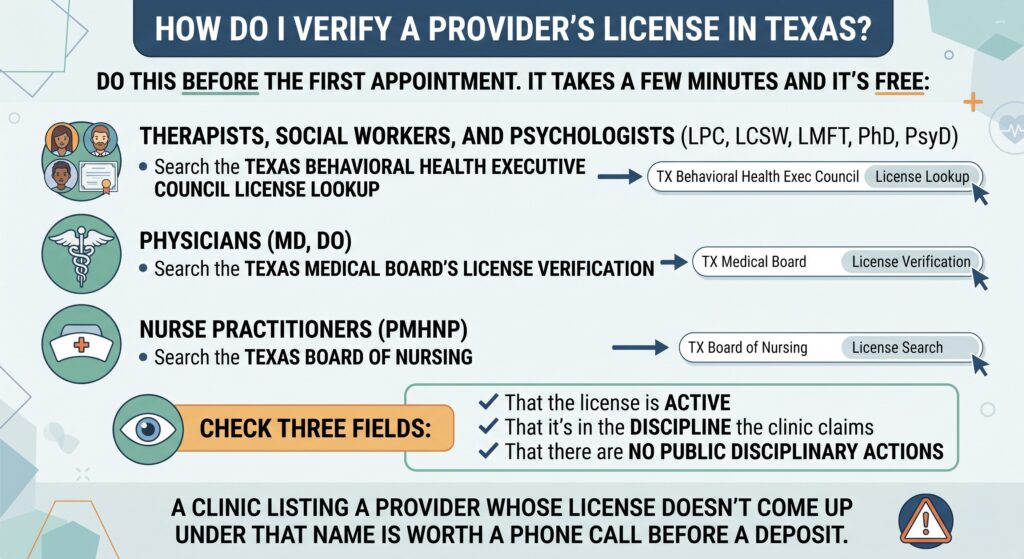
Do this before the first appointment. It takes a few minutes and it’s free:
- Therapists, social workers, and psychologists (LPC, LCSW, LMFT, PhD, PsyD) — search the Texas Behavioral Health Executive Council license lookup
- Physicians (MD, DO) — search the Texas Medical Board’s license verification
- Nurse practitioners (PMHNP) — search the Texas Board of Nursing
Check three fields: that the license is active, that it’s in the discipline the clinic claims, and that there are no public disciplinary actions. A clinic listing a provider whose license doesn’t come up under that name is worth a phone call before a deposit.
What should I ask before I book — and what are the red flags?
Six questions worth asking the front desk when choosing a mental health clinic:
- Who will I see, and what license do they hold?
- Are you in network with my specific plan, and what’s my behavioral health copay after deductible?
- How long until a first appointment, and how long until a recurring slot?
- Do you offer therapy and medication management in the same practice?
- What’s the cancellation window and fee?
- Who covers urgent questions between appointments?
Red flags, in our experience: a practice that guarantees a specific outcome or timeline, quotes a treatment success rate without naming a source, pressures you toward a paid package on a first call, won’t name your provider before the appointment, or can’t tell you what it doesn’t treat. None of those are minor.
Frequently asked questions about choosing a mental health clinic
Is a psychiatrist better than a therapist?
Neither is better — they do different work. Psychiatrists and other prescribers handle diagnosis, medication, and medical complexity. Therapists provide the talk therapy itself. Many people see both at once, and for moderate depression, anxiety, or ADHD, that combination is common.
How long should I wait for a first appointment?
Wait times vary widely by clinic and by provider type; prescriber intakes generally book out further than therapy intakes. Ask for both numbers. If a wait is longer than you can safely manage, say so on the call — most practices triage.
What if I don’t like the provider I’m assigned?
Say so, ideally after two or three sessions. Fit is a clinical variable, not a matter of manners, and a well-run practice will reassign you internally rather than lose you. That is a reasonable thing to ask about before you book.
If you need help right now
If you’re thinking about harming yourself or someone else, don’t wait for an appointment. Call or text 988 to reach the Suicide and Crisis Lifeline, available 24/7, or go to your nearest emergency department.
This article is general educational information and is not a substitute for individualized assessment, diagnosis, or treatment by a licensed clinician. Treatment recommendations vary by person. If you have urgent concerns about your safety, call 988 or seek emergency care.
Choosing a mental health clinic carefully now means you won’t have to start over later. Run through these checks, verify the license, and book with confidence.
Start with an evaluation, not a guess